
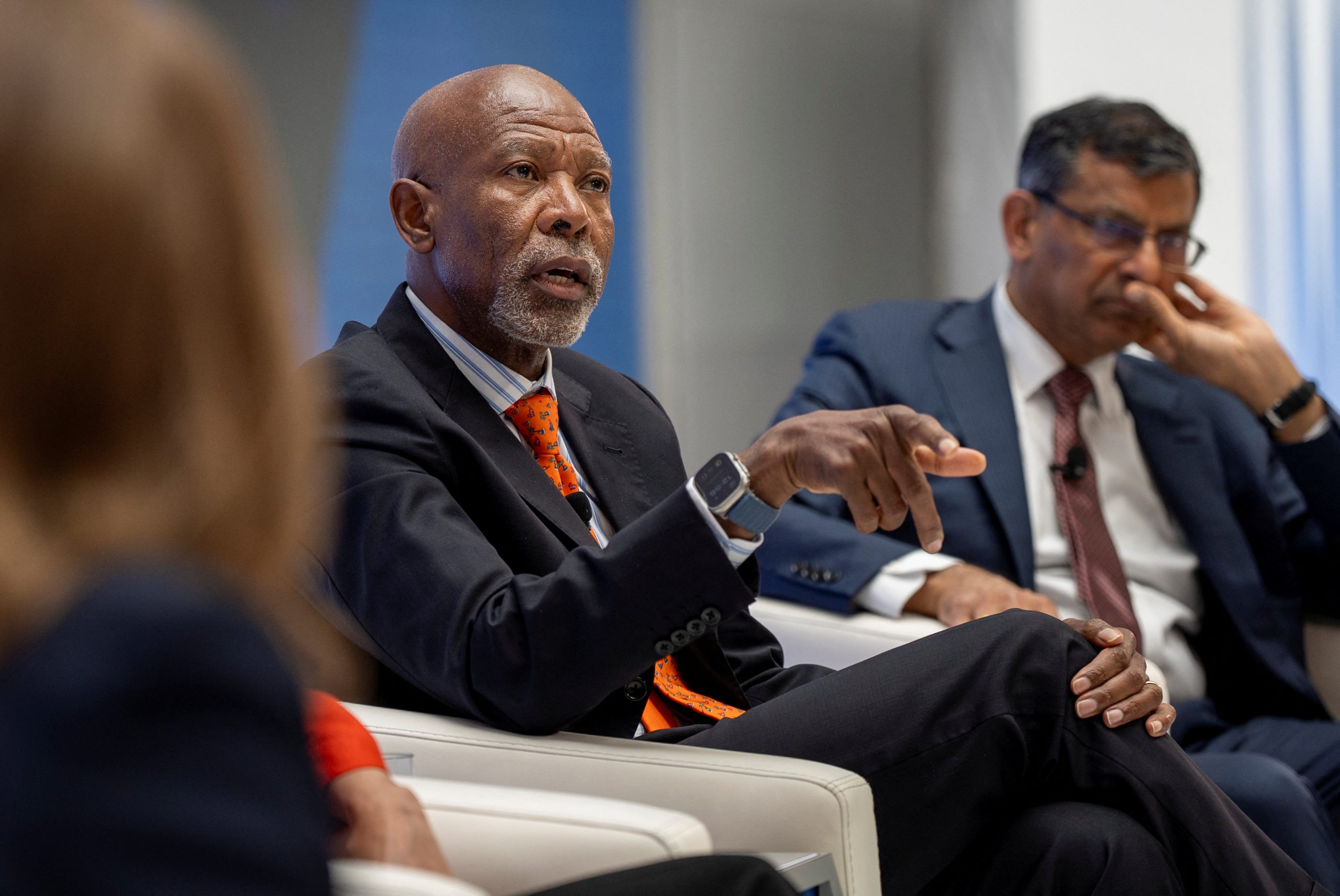
Governor of the South African Reserve Bank Lesetja Kganyago speaks during a press briefing at the 2025 annual IMF/World Bank Spring Meetings in Washington, DC, 25 April 2025. © Ken Cedeno
Published on November 16, 2026 at 18:30 pm (GMT +1)
When Lesetja Kganyago, governor of the South African Reserve Bank, was asked about Africa’s ambition for a common currency, he did not mince words.
Without banking union and fiscal discipline, he told fellow central bankers gathered in Luanda, a common currency was “just a pipe dream”. Attempting it without those foundations would “just introduce instability”.
The surprise at the Africa Financial Industry Summit was how little resistance he met. The governors of Rwanda, Angola and the eight-country West African monetary union all favoured deeper integration. The most useful steps, they believe, will come before, rather than after, any decision to surrender national currencies.
The African Union envisages establishing an African Central Bank between 2028 and 2034, with a common currency as its eventual goal. West African governments are targeting 2027 for their proposed eco, while East Africa has pushed back its monetary-union deadline to 2031.
Yet the conditions for a continent-wide monetary union remain distant. Inflation, debt burdens, access to foreign exchange and the structure of national economies differ too greatly to make one interest rate an obvious fit.
Rwanda’s central bank governor, Soraya Hakuziyaremye, described the problem in miniature. Her country imports fuel and fertiliser, making it vulnerable to rises in global prices. Domestic tax reforms had already increased inflationary pressure before the war involving Iran “added another shock”.
The National Bank of Rwanda responded by tightening monetary policy. Growth nevertheless reached 9% in the first half of 2026, she said. A common monetary authority might have made a different choice for the region as a whole.
When we speak of monetary union, for us it is not a theory. We have been working within a monetary union for years
Angola faces the opposite side of the oil-price equation. As Manuel António Tiago Dias, governor of its central bank, explained, foreign-exchange flexibility helped the economy absorb a sharp fall in export receipts in 2023 while preserving international reserves.
The eurozone offers an uncomfortable lesson. Its founding states shared a currency before establishing a banking union or effective mechanisms for sharing the costs of a crisis. When sovereign debt and banking stress reinforced each other in the 2010s, countries like Greece that could no longer devalue were forced into painful domestic adjustments. Macroeconomic convergence on paper was no substitute for institutions capable of handling a shock.
West Africa’s real-world experiment
Jean-Claude Kassi Brou offered a defence of what shared institutions can achieve.
“When we speak of monetary union, for us it is not a theory,” said the governor of the Central Bank of West African States (BCEAO). “We have been working within a monetary union for years.”
The BCEAO runs monetary policy for eight economies using the CFA franc. One regional banking regulator, pooled foreign-exchange reserves and a common government-bond market, he argued, provide stability that individual countries would struggle to match.
If a member’s export earnings fall, it can benefit from collective reserves; if its treasury needs financing, banks elsewhere in the bloc can buy its bonds.
There is substance to that case. The IMF estimates that the West African Economic and Monetary Union grew by 6.6% in 2025, with reserves recovering to 7.8 months of import cover by February 2026. Its common currency eliminates exchange-rate risk among members, although its peg to the euro limits adjustment against external currencies.
Yet the same market that pools risk can spread it. IMF analysis found that sovereign exposures accounted for around 38% of WAEMU banks’ assets in 2025. Senegal’s public debt stood at about 130% of GDP, far above the union’s 70% ceiling.
The danger is familiar from Europe: banks finance governments, and a sovereign crisis can weaken the banks that hold their debt. Kassi Brou’s fiscal rules are therefore essential to his success story, rather than evidence that the problem has been solved.
Integration from the bottom up
For Kganyago, there was a more immediate alternative: integrate from the bottom up.
Southern Africa already has a regional real-time gross settlement network for banks. Connecting such systems across regions, alongside national instant-payment networks, could reduce the need to route transactions through correspondent banks abroad, often using dollars or euros even when both parties are African.
“We are talking about a continental free trade agreement,” Kganyago said. “Trade must be settled at some point.”
The contradiction is glaring. Under the African Continental Free Trade Area, governments are trying to create a single market, yet businesses can still struggle to pay suppliers across a nearby border.
The Pan-African Payment and Settlement System (PAPSS), backed by Afreximbank, aims to tackle that problem. By July 2026, it counted 28 participating countries, more than 190 commercial banks and fintechs, and 16 payment switches.
But joining a network is not the same as processing transactions at scale. Many participants have yet to integrate PAPSS fully into their operations.
Hakuziyaremye supplied an example of what is possible.
“Do we wait for that single currency to happen before we link our payment systems?” she asked. “Or can we adopt those interim steps that actually allow us to accelerate financial integration?”
Rwanda and Tanzania are piloting a link between their domestic instant-payment systems, allowing traders to pay suppliers across the border more cheaply.
She also described work with Ghana and Kenya on licence passporting, designed to make it easier for fintech companies approved in one country to enter another without repeating the entire licensing process.
The caution is that payment systems cannot conjure up foreign exchange. Someone must provide local-currency liquidity, quote the conversion rate, and carry the risk if currencies move sharply. Capital controls and differing regulations can still frustrate a transfer.
An African Development Bank study found that 36% of banks surveyed cited foreign-exchange shortages as their biggest constraint to expanding trade finance. Faster settlement is an advance, not a substitute for deeper financial markets.
Southeast Asia provides an alternative model. ASEAN has been linking instant-payment systems across borders without pursuing monetary union. Integration can begin with the everyday needs of businesses rather than a treaty establishing a common central bank.
Beyond financial plumbing
Dias went further, insisting that finance must serve the real economy.
“The Angolan authorities have been investing heavily in infrastructure,” he said, referring to airports, roads and railways. “We are not looking only at Angola. We are also considering the benefits they can bring to neighbouring countries.”
Angola’s investments in the Lobito Corridor and a new refinery are intended to serve neighbouring markets, notably the Democratic Republic of Congo and Zambia. But moving goods across borders also requires reliable transport, customs reform and electricity.
The governors were not proposing to abandon a single African currency. Rather, they drew a distinction between the symbolism of monetary union and the difficult work of economic integration.
A regional business does not need to wait for an African central bank to make a payment, obtain finance or expand into the next market. If regulators can make those transactions work, they may build both the commercial links and the political trust that any future currency union would require.
Africa’s financial integration may advance faster if its governments stop treating a single currency as the necessary starting point.
-
Nicholas Norbrook
Managing Editor of The Africa Report



No comments yet. Start the conversation.