
By James Ogunnaike, Abeokuta
Former Chairman of the Nigerian Medical Association (NMA), Ogun State Branch, Dr. Kunle Ashimi, has called for the adoption of Artificial Intelligence (AI) and telemedicine to address healthcare challenges in Africa, particularly the shortage of medical personnel and limited access to specialist services in rural communities.
Ashimi made the call in Abeokuta while delivering the keynote address at the grand finale of The Concept Academy Intercollegiate Medical Essay Competition 2026, where he spoke on the theme, “Improving Healthcare in Africa Through Artificial Intelligence and Telemedicine.”
He said Africa, with a population of over 1.4 billion people, was grappling with an inadequate healthcare workforce, noting that the shortage of doctors and other medical professionals had continued to widen the gap between patients and access to quality healthcare.
According to him, the situation had created room for unqualified individuals to pose as medical practitioners, thereby exposing vulnerable patients to avoidable health risks.
He said, “when qualified professionals are unavailable, people may turn to individuals who lack the necessary training and expertise. This shortage creates an environment in which quackery can thrive.”
Ashimi argued that technology could help bridge the healthcare gap by strengthening existing medical services rather than replacing healthcare professionals.
He identified predictive triage, remote diagnostics and multilingual AI agents as three major areas through which artificial intelligence could transform healthcare delivery across the continent.
Explaining predictive triage, he said AI-powered systems could assess patients’ vital signs, including temperature, heart rate, respiratory rate, height and weight, to determine the urgency of their medical conditions and direct them to appropriate specialists.
He added that such technology could reduce unnecessary delays in hospitals, improve patient prioritisation and ensure that emergency cases received prompt attention.
On remote diagnostics, Ashimi posited that telemedicine could enable patients in underserved communities to access specialists in major cities without travelling long distances, adding that nurses and community health workers could facilitate consultations and examinations at the local level.
He also advocated the development of AI systems capable of communicating in indigenous African languages, including Yoruba, Igbo, Hausa and Swahili, to overcome language barriers that often prevent patients from adequately explaining their health conditions.
The medical expert cited indigenous technological innovations, including AI-assisted screening for tuberculosis through chest X-rays and technology designed to detect neonatal asphyxia, as examples of how African-developed solutions could improve healthcare outcomes.
He also highlighted the application of AI in analysing retinal images to identify abnormalities associated with diabetes and other eye conditions.
Addressing concerns about the possible displacement of medical professionals by artificial intelligence, Ashimi maintained that the technology should complement rather than replace doctors.
“AI is more likely to replace doctors who refuse to adapt to the use of AI than doctors who understand how to use it effectively,” he said.
He further advocated the integration of electronic medical records into healthcare facilities, explaining that digitised patient information would enable authorised medical professionals to access medical histories and previous test results, irrespective of patients’ locations.
Ashimi said Africa should work towards achieving 90 per cent healthcare digitisation by 2035, stressing that geographical location should not determine people’s access to quality medical services.
Earlier, the President and Founder of The Concept Academy, Dr Festus Oluseye Babarinde, challenged young medical professionals to look beyond personal career ambitions and deploy their education, knowledge and professional influence towards addressing Nigeria’s healthcare challenges.
He disclosed that 1,556 applicants participated in the 2026 competition, describing the response as an indication of the growing interest of young medical students in contributing to healthcare development.
Babarinde said the initiative was established to encourage future doctors to critically examine the country’s healthcare challenges and develop ideas capable of improving the sector.
He explained that The Concept Academy was initially established to help young doctors prepare for the United States Medical Licensing Examination (USMLE), but its broader vision was rooted in the conviction that medical knowledge should ultimately improve people’s lives.
“When we founded The Concept Academy, our immediate goal was to help young doctors prepare for the United States Medical Licensing Examination. Beneath that ambition lay a conviction that still guides us: talent deserves opportunity, and knowledge gains its greatest value when it improves others’ lives,” he said.
Babarinde described the essay competition as an opportunity for medical students from universities across Nigeria to examine the realities of the healthcare system, undertake research and contribute thoughtful perspectives on possible solutions.
He said, “the shade we enjoy today comes from trees planted long ago,” he urged educators, mentors and institutions to invest deliberately in developing young people whose contributions would benefit future generations.
Drawing from his experience practising medicine in Nigeria and subsequent public health studies at Johns Hopkins University, he said effective medical practice required more than clinical competence.
According to him, doctors must also understand the social and economic circumstances that determine whether people can access healthcare in the first place.
“My years of medical practice in Nigeria showed me what a functioning clinic can mean to a community: a mother receiving timely care, a child spared a preventable complication, a family finding reassurance where there had been fear,” he said.
He added that the experience had strengthened his conviction that a doctor’s responsibility extended beyond treating patients who arrived at hospitals to understanding the circumstances preventing others from accessing medical attention.
Congratulating the participants and finalists, Babarinde commended their willingness to undertake research, think critically and contribute to conversations about healthcare despite the demanding nature of medical education.
He urged the finalists to receive their recognition with humility, reminding them that achievement also came with greater responsibility.
He also acknowledged the competition’s judges, particularly Dr Okonkwo and his team, for their diligence in assessing the essays, while appreciating the sponsors, partners, university lecturers, teachers, parents and members of The Concept Academy team for supporting the initiative.
In a charge to the young medical professionals, he urged them to ensure that their education served not only their personal ambitions but also disadvantaged patients and communities whose healthcare challenges often received little public attention.
“Let your education reach beyond your ambition. May what you learn serve the patient who cannot repay you, the community whose struggles seldom make the headlines, and the younger student who will one day look to you for guidance,” he said.
He encouraged them to pursue professional excellence without losing the compassion and humanity that should define the medical profession.
Emphasising the human dimension of healthcare, Babarinde declared: “Beyond the page is someone waiting for care, someone counting the cost, someone hoping to be heard.”
He urged the participants to pursue excellence while maintaining compassion and a commitment to serving vulnerable communities.
“The distance between illness and recovery is sometimes measured in kilometres, sometimes in naira, and sometimes in the availability of a single doctor,” he said.
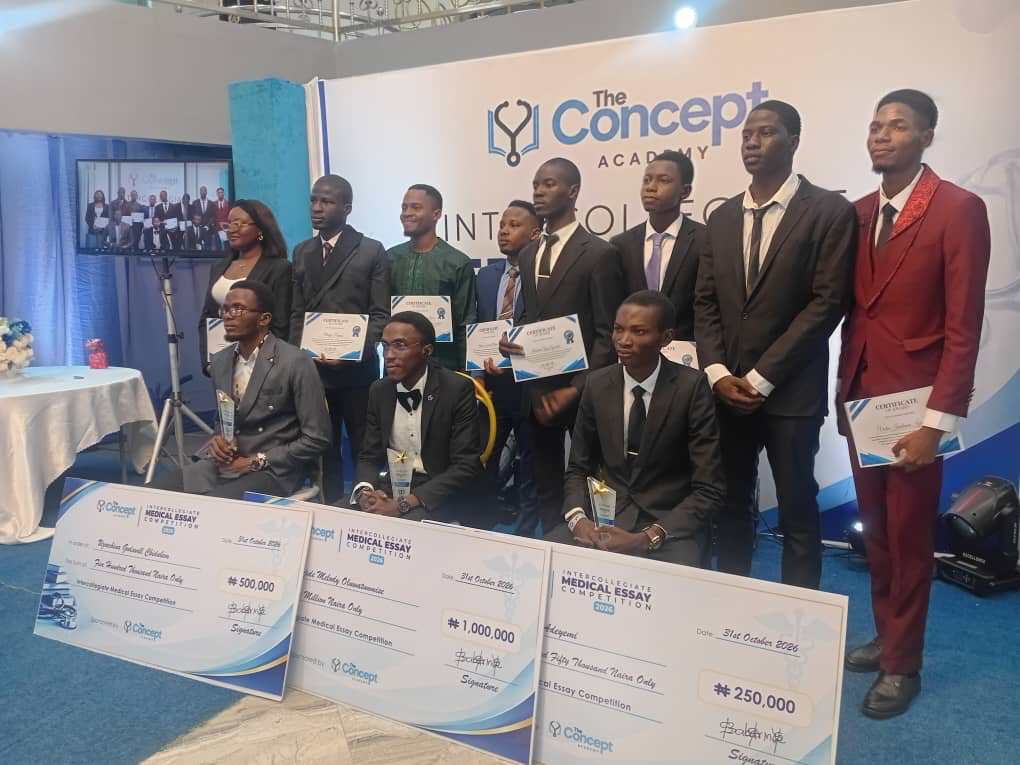
In the competition’s final results, Melody Oluwatunmise Olajide of the University of Ibadan emerged first and received a cash prize of N1million, Godswill Chidubem came second and received N500,000, while Aremu Enoch Abidemi placed third and received N250,000.
Congratulating the finalists, Babarinde urged them to see their achievements as a call to greater responsibility, adding that medical education should extend beyond personal ambition to improving the lives of patients and communities.
He also commended the judges, organisers, sponsors, lecturers, teachers and parents for their contributions to the success of the competition.
Meanwhile, Melody Olajide, the overall winner of the essay competition, described the experience as a mind-blowing and rewarding journey, expressing appreciation to the organisers for providing young people with an opportunity to showcase their writing talents.
He said, “From the whole experience, from beginning to end, it was mind-blowing. From the call for applications, we submitted abstracts, we got selected, then we submitted our full essays, we got shortlisted again, and then we were contacted as we went on. From start to finish and now we are here today, it’s a very wonderful experience, and I really appreciate Concept Academy for this initiative.”
Advising the young people, he encouraged them to remain consistent in pursuing their talents, irrespective of their chosen fields.
“To every young person out there, just be yourself and always keep applying. Keep writing if you write, keep singing if you sing, keep dancing if you dance, and keep making content if you are a content creator. Keep putting yourself out there, and one day people will recognise who you truly are and you will receive recognition and prizes for what you do best,” he said.




No comments yet. Start the conversation.