
.seeks greater investment in Egbaland
By James Ogunnaike, Abeokuta
The Alake and Paramount Ruler of Egbaland, Oba Adedotun Aremu Gbadebo, has called on the people of Egbaland to take collective ownership of the proposed Egba Development Plan 2027–2037, urging successive governments to give Abeokuta and its surrounding communities the level of infrastructural investment befitting their historical and political importance.
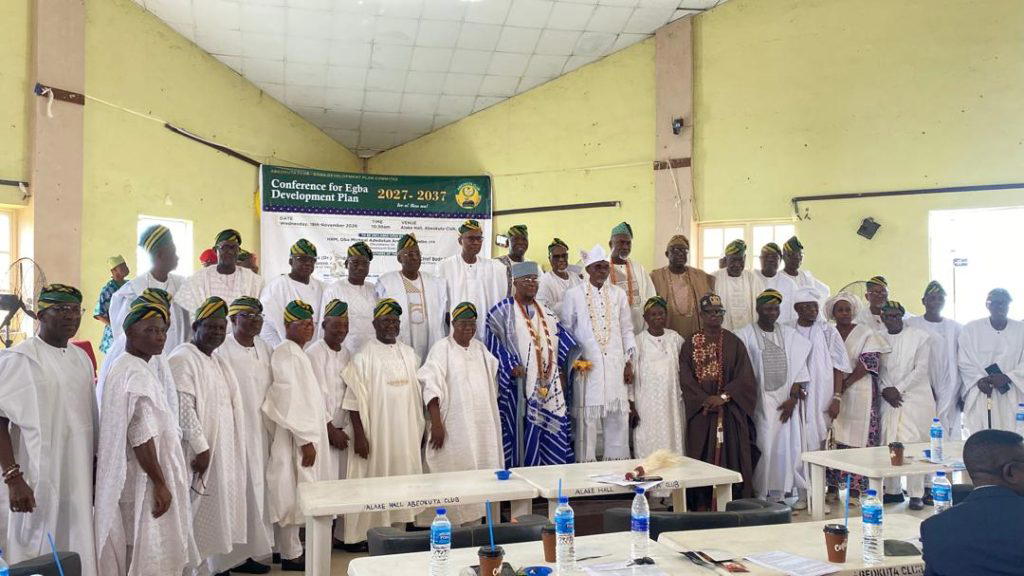
The monarch made the call at the Egba Development Plan 2027 Stakeholders’ Conference, held on Wednesday at Alake Hall, Abeokuta Club, Abeokuta, Ogun State.
The conference, organised by Abeokuta Club, brought together traditional rulers, professionals, business leaders, government representatives, institutional stakeholders and members of the Egba community to deliberate on a comprehensive development framework intended to reposition Egbaland over the next decade.
Oba Gbadebo, who commended the initiative, described the development plan as a timely intervention, particularly in view of the impending transition in the Ogun State government.
He urged the people to move beyond merely endorsing the document and actively participate in its implementation.
“We have already told them that anyone who fails to plan has already planned to fail. Therefore, if you have no plan that you are working towards, you are putting yourself in a precarious position,” the monarch said.
“I want to charge all of you that, wherever you are and whatever position you occupy, once the development plan is promulgated, you should take ownership of it and become an ambassador for Egbaland in promoting its implementation.”
The Alake expressed concern that Abeokuta, despite being the Ogun State capital, had not received the level of government investment and infrastructural development commensurate with its status.
He argued that the designation of a city as a state capital should translate into deliberate investment in infrastructure, economic activities and public facilities.
“It is particularly significant that this is happening at a time when the government of Ogun State is changing hands. This is the right time for us to promote the development plan for Egbaland,” he said.
“Over the years, we have been shortchanged because we have not received the attention and development we deserve. The state government has not invested sufficiently in its capital city.”
Drawing comparisons with Lagos and Abuja, the monarch questioned why Abeokuta should be treated differently from other capital cities that had benefited from substantial government investment.
“When you designate a place as your capital, it deserves the necessary attention and investment. When Lagos was the capital of Nigeria, it received enormous development and investment. Our economic position today is also influenced by the fact that Abuja has attracted virtually everything that was once available in Nigeria for its own development. So, why should Abeokuta, the capital of Ogun State, be treated differently?” he asked.
The monarch also acknowledged the contribution of a former Ogun State governor from Egbaland, Senator Ibikunle Amosun, to the transformation of the area’s road network, particularly the expansion of roads from two lanes to six lanes.
“We thank God that we had a son of the soil who transformed our roads from two lanes to six lanes across Egbaland. Because of what he did for Egbaland, he became an enemy of many people. However, we know that what he did was what he was expected to do and what others before him should also have done,” he said.
Oba Gbadebo further described Egbaland as Nigeria’s educational capital, insisting that the area must sustain its historical leadership in education through continuous investment and development.
“We are the educational capital of Nigeria, and nobody is competing with us in that regard. We know that once you have education, you have everything else,” he said.
He also emphasised the need for balanced development across the geographical and traditional communities that constitute Egbaland, noting that development priorities must reflect the peculiar needs of individual areas.
“We are not just six local government areas; we are six and a half. Olota is a member of the Egba Traditional Council. Therefore, every inch of the territory known as Egbaland must experience development,” he added.
The Alake commended Abeokuta Club for initiating the development plan, expressing optimism that it would usher in a new era of collective action and sustainable growth.
In a keynote presentation titled, “Abeokuta Among Great West African Cities: Proud Heritage, Present Strengths and a Bold Vision for the Future,” the Olowu of Owu Kingdom, Oba Adeola Matemilola, challenged Egba people to translate their rich historical heritage, educational institutions, cultural resources and strategic geographical location into sustainable economic growth and international recognition.
The monarch observed that although the Egba had established an enviable reputation through their contributions to education, journalism, politics, commerce and cultural development, Abeokuta needed to move beyond celebrating its glorious past and embrace a coordinated strategy for economic transformation.
Identifying Abeokuta’s proximity to Lagos, transportation connections, educational institutions and strategic position within Ogun State’s industrial economy as significant competitive advantages, Oba Matemilola said these assets must be deliberately harnessed to stimulate investment and economic expansion.
He advocated stronger collaboration among tertiary institutions, the private sector and government to promote research, innovation, entrepreneurship and skills development.
The Olowu identified manufacturing, agro-processing, energy, tourism, technology and the creative industries as priority sectors capable of driving the city’s economic growth.
A major highlight of his proposed transformation agenda was the ambition to position Abeokuta as an international centre for Adire textiles and African fashion.
To achieve this, he proposed the establishment of an Adire and African Textile Development Centre to promote traditional textile research, skills acquisition, modern production techniques, quality standardisation, digital marketing and export development.
He explained that the initiative would enhance the commercial value of Adire, create employment opportunities, empower local artisans and expand the international market for indigenous textile products.
Oba Matemilola also presented a three-phase development roadmap covering the 10-year period from 2027 to 2037.
“The first phase, covering 2027–2028, would focus on preparing an Abeokuta Metropolitan Development Master Plan, establishing a city development and investment forum, documenting historical assets and identifying priority infrastructure projects”.
“The second phase, scheduled for 2029–2031, would concentrate on urban renewal, technology development, industrial and agro-processing investments, improved public transportation, tourism infrastructure and youth employment.”
“The final phase, covering 2032–2037, would seek to establish Abeokuta as a recognised West African destination for heritage tourism, education, research, innovation and export-oriented industries”.
He stressed that achieving the proposed objectives would require sustained collaboration among government, traditional institutions, the private sector, educational institutions, community organisations, women, young people and Egba indigenes in the Diaspora.
On funding, the Olowu recommended a diversified financing structure involving government allocations, public-private partnerships, development finance, private-sector investments, Diaspora contributions and tourism-related partnerships.
Earlier, the Chairman of the Committee on Egba Development Plan 2027–2037, Chief Adebayo Ayodele, said the initiative was conceived against the backdrop of the historic achievements of the Egba United Government and the subsequent deterioration of several institutions and developmental structures established by the community’s forefathers.
In his address titled, “Why We Are Here,” Ayodele recalled that the Egba United Government played significant roles in developing commerce and industry, education, railway and road infrastructure, healthcare, security and public administration.
He noted that these achievements reflected the vision, organisational capacity and administrative ingenuity of the Egba people in an earlier era.
He, however lamented that many of the institutions and structures that once distinguished Egbaland had deteriorated considerably, making a comprehensive and coordinated development strategy imperative.
According to Ayodele, the committee was mandated to develop a comprehensive 10-year framework that would identify developmental challenges, assess existing institutions and infrastructure, and recommend practical and sustainable solutions.
He disclosed that the committee’s assignment included consultations with stakeholders across the six local government areas of Ogun Central Senatorial District to identify their priorities and determine the interventions required to improve their socio-economic conditions.
He explained that the proposed development plan was structured around six strategic pillars: economic sovereignty, infrastructure, human capital development, security and justice, identity and culture, and institutional capacity for development.
Ayodele maintained that the six pillars were interconnected and mutually reinforcing, noting that sustainable economic development could not be achieved without adequate infrastructure, quality human capital, security, effective institutions and the preservation of cultural identity.
He stressed that the committee was determined to produce an implementation-driven blueprint rather than another development report that would eventually be abandoned.
“Our aspiration is not to produce another development document that will eventually gather dust on a shelf. We seek to develop a practical roadmap with clearly defined priorities, achievable targets, appropriate institutional responsibilities and sustainable implementation mechanisms,” he stated.
The committee chairman also called for a departure from short-term political considerations and what he described as “stomach infrastructure” in favour of a development-oriented approach that prioritises enduring public infrastructure, economic opportunities, quality education, accessible healthcare, security, justice and institutional development.
In his presidential address, the President of Abeokuta Club, Chief Adewale Adeola explained that the proposed framework was intended to serve as a permanent reference document for engaging successive governments, political office seekers, development partners, individuals and organisations interested in the advancement of the area.
The club president emphasised that the development plan must remain relevant irrespective of changes in government or the political affiliations of those occupying positions of authority.
“Our objective is to ensure that the collective aspirations of the Egba people are clearly articulated, adequately documented and consistently pursued, irrespective of political affiliation, changes in government or the personalities occupying positions of authority,” he said.
He expressed the hope that the conference would generate practical recommendations, strengthen stakeholder participation and establish a common development agenda capable of guiding Egbaland towards sustainable growth and prosperity over the next decade.




No comments yet. Start the conversation.