
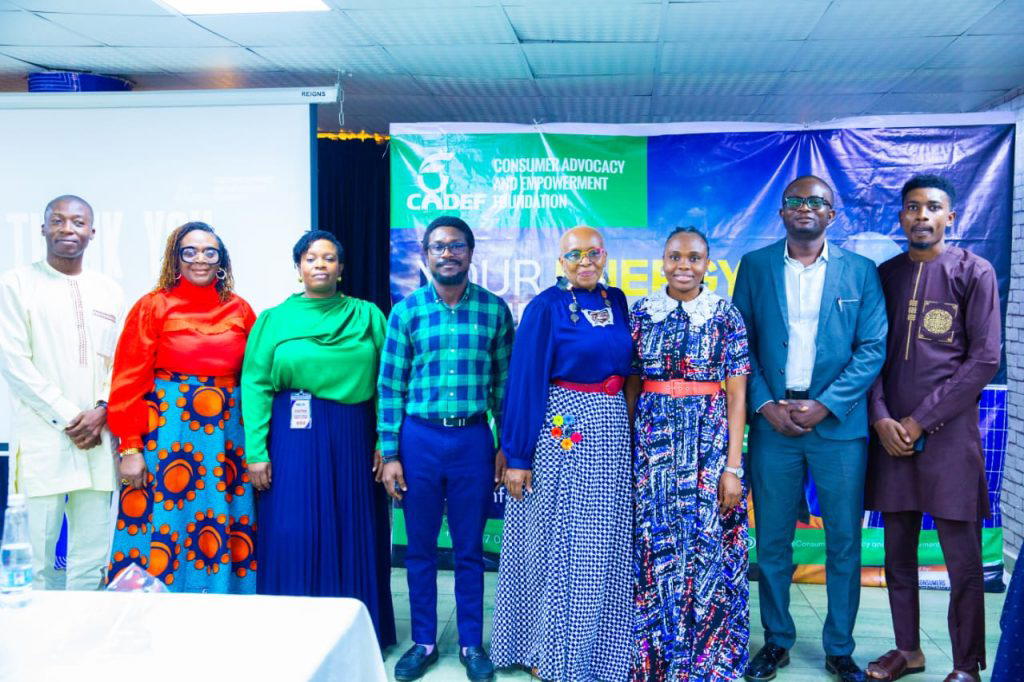
…Calla for consumer-focused energy reforms
By Juliet Umeh
The Executive Director of the Consumer Advocacy and Empowerment Foundation, CADEF, Prof. Chiso Ndukwe-Okafor, has warned that Nigeria’s energy crisis is deepening as households and businesses contend with inadequate electricity supply and the high cost of alternative energy.
Speaking at the Renewable Energy Access Summit 2026, Ndukwe-Okafor said the country faced both an energy access deficit and energy poverty, leaving many consumers unable to afford either grid electricity or other sources of power.
“Many countries experience energy poverty, where electricity is available but too expensive for people to afford. Nigeria, however, suffers from both problems,” she said.
“We have an energy access problem because we do not have sufficient electricity, whether from the grid or alternative sources. We also experience energy poverty because we can’t even afford what is given to us or what we would like to get.”
A consumer survey presented at the summit found that 45 per cent of respondents relied on generators as backup power, although most earned less than N100,000 monthly.
The survey also showed that 30 percent reported inadequate energy access, while 21 percent sometimes cut back on electricity consumption and 18 percent said they always reduced their energy use. Five per cent said they could never afford the energy they needed.
Ndukwe-Okafor said the findings showed that electricity challenges were affecting consumers’ daily lives and economic activities. She questioned the fairness and consistency of electricity supply bands, particularly where consumers on the same feeder did not receive the hours of supply promised.
She also identified low confidence in government and electricity providers as an obstacle to power-sector reform.
“Trust should not be treated as a secondary consideration. It is an essential component of our energy infrastructure,” she said.
According to the survey, 66 percent of respondents expressed low trust in the government, while 57 percent reported low trust in electricity distribution companies. Forty percent did not know who regulated electricity in their states, while 79 percent knew about the Nigerian Electricity Regulatory Commission but did not understand its functions.
Only six percent of respondents were aware of grid-related improvements in their areas.
Despite the difficulties, the survey found strong interest in renewable energy, with 89 percent saying they would consider adopting it within two years. However, high upfront costs and limited financing remained major barriers, while 19 percent said they did not trust renewable energy vendors.
Ndukwe-Okafor called for stronger consumer protection, more transparent information and greater accountability from energy service providers. She said consumers needed reliable guidance to make informed decisions before investing in renewable energy systems.
CADEF unveiled an upgraded Renew Energy Naija digital platform at the summit to help Nigerians understand distributed energy options, estimate household solar requirements and identify service providers. The platform includes a solar calculator, a service-provider directory and educational materials on solar systems, battery storage and mini-grids.
Earlier, the Director of Programmes at CADEF, Lovelyn Okafor, said renewable energy access was incomplete if consumers did not know which providers to trust.
“Access is no longer enough. A solar panel on the rooftop is not renewable access if the consumer does not know which provider to trust,” she said.
Okafor said consumers needed information they could understand and a meaningful way to contribute to decisions affecting their lives.
“A new resolution cannot empower consumers if it is written in language they cannot understand. An energy market cannot truly be considered consumer-centred if consumers have no meaningful way to address decisions that affect their lives,” she said.
Olufunmi Adewale, who delivered the keynote address on behalf of the Founder and National President of the Women in Renewable Energy Association, Chief Dr. Anita Nana Okuribido, called for more accessible financing for women-led businesses and low-income consumers.
She proposed pay-as-you-go arrangements, equipment financing, working-capital support, loan guarantees and patient capital, saying women should be able to participate in the renewable energy market as consumers, entrepreneurs and investors.
The Director of Research and Data Analytics at NERC, Abdullahi Adamu, said the commission had issued mini-grid and net-billing regulations to support distributed energy development. He added that 17 states had completed the process of establishing and assuming regulatory oversight of their electricity markets.
Adamu said the Mini-Grid Regulations covered isolated mini-grids of up to five megawatts per site and interconnected mini-grids of up to 10 megawatts. He said the Forum of Nigerian Electricity Regulators would also help coordinate oversight across federal and state electricity markets.




No comments yet. Start the conversation.