
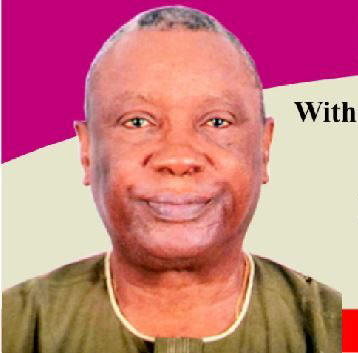
Professor Joash Amupitan hails from Ayetoro Gbede in Ijumu Local Government Area of Kogi State.
If we are to judge Ayetoro Gbede by the likes of Senator Dino Melaye, what of notables like Major General (rtd) David Medayese Jemibewon (86), Shola Ameobi, who once played for Newcastle United football club in the English Premiership, John Obaro, founder of Systemspecs, and others?
I first visited Ayetoro Gbede in 1975 when it was part of Kwara State. I was there for the grand reception by the people of Ayetoro Gbede in honour of Colonel Jemibewon, who was appointed the Military Governor of Western State to replace Captain Akintunde Aduwo (86). I was then the Western State Editor of the Kwara State-owned THE NIGERIAN HERALD, reporting from Ibadan.
The people of Ijumu have a passion for education. They are intrepid and doughty. They are fearless. I have in mind the likes of Chief Bayo Ojo, SAN, CON; Senator Smart Adeyemi, Lt. General (rtd.) Rufus Modupe Kupolati, Lt. General (rtd.) Joseph Olorungbon Owonibi, Major General (rtd) Funso Samson Owonibi, Mrs Folashade Yemi-Esan, Dapo Olorunyomi, CON, Mr. Eniola Bello, Gbenga Ogunleye, Prince Olushola Akanmode, Mr. Tunde Ipinmisho, S. A. Ajayi, Professor Yemi Akinwumi, Professor Gbenga Ibileye, Honourable Abiodun James Faleke, Barrister Ayo Abraham Olorunfemi and so many others.
Coincidentally, an illustrious Ijumu Professor is to conduct our coming general elections. Those who love Nigeria must wish Professor Joash Ojo Amupitan the best of luck.
After the Constitutional conference in London, it was agreed that an electoral body be established for the 1959 elections and other elections. Mr. Roland Edward Wraith was therefore appointed to head the body. Other members of the commission were Alhaji Bello Dan Amar, Mr. Anthony Aniagolu, Mr. H. Orisejolomi Thomas, Mr. K.A. Bohu and Mr. M. A. Sho-Silva. Mr. Orisejolomi Thomas later resigned to go back to academics, which was his calling, and was replaced by Prince Peter Akenzua.
Mr. Ronald Edwards Wraith was born in 1908 in Derby, Derbyshire, England. He was a British scholar and public administrator specializing in colonial and post-colonial governance in Africa. Mr. Wraith authored influential studies on local government systems in West Africa, including examinations of structures in Nigeria, Ghana, and Sierra Leone, and co-wrote Corruption in Developing Countries (1963) with Edgar Simpkins, analyzing administrative challenges and graft in emerging nations. His works emphasized practical reforms to build effective institutions amid decolonization, drawing from direct experience in British colonial service.
His tenure, which extended until 1960, focused on establishing impartial mechanisms for voters’ registration and election conduct amid Nigeria’s diverse ethnic and regional divisions. Mr. Wraith, drawing from his prior administrative experience in colonial service, prioritized logistical preparations, including the compilation of electoral rolls across Nigeria’s expansive territory, where infrastructure limitations posed significant hurdles such as inadequate transportation and communication networks.
Under Mr. Wraith’s leadership, the ECN organized the 1958 regional elections, which served as a precursor to federal polls, achieving widespread voter registration despite challenges like low literacy rates and geographic isolation in rural areas. The subsequent 1959 federal elections, held on December 12, saw the Northern People’s Congress secure 134 seats in the 312-member House of Representatives, forming a coalition government with the National Council of Nigeria and the Cameroons.
Voter participation reached approximately 79.5%, reflecting effective mobilization efforts, though ethnic-based campaigning intensified regional rivalries. Wraith’s commission addressed logistical issues by deploying polling stations in remote locations and training local staff, enabling the process to proceed without widespread disruption despite predictions of potential violence. The outcomes of these elections contributed to short-term political stability, paving the way for Nigeria’s independence on October 1, 1960, with Alhaji Abubakar Tafawa Balewa appointed as Prime Minister.
Success metrics included the acceptance of results by major parties, minimal reported irregularities in vote counting, and the establishment of a precedent for federal oversight of polls. However, persistent ethnic tensions, evident in the uneven regional vote distributions—such as the Northern People’s Congress dominating the North while the Action Group prevailed in the West—foreshadowed future instability, including the 1964 election crises that undermined the nascent democratic framework. Wraith’s role emphasized procedural integrity over partisan influence, though critics later noted that structural ethnic imbalances limited long-term cohesion
To be continued
•Eric Teniola, a former director at the Presidency wrote from Lagos.

No comments yet. Start the conversation.