
By Osa Mbonu-Amadi
Fine art photographer and visual artist Adeife David captures culture as an everliving entity that thrives through human beings, rituals, and memory.
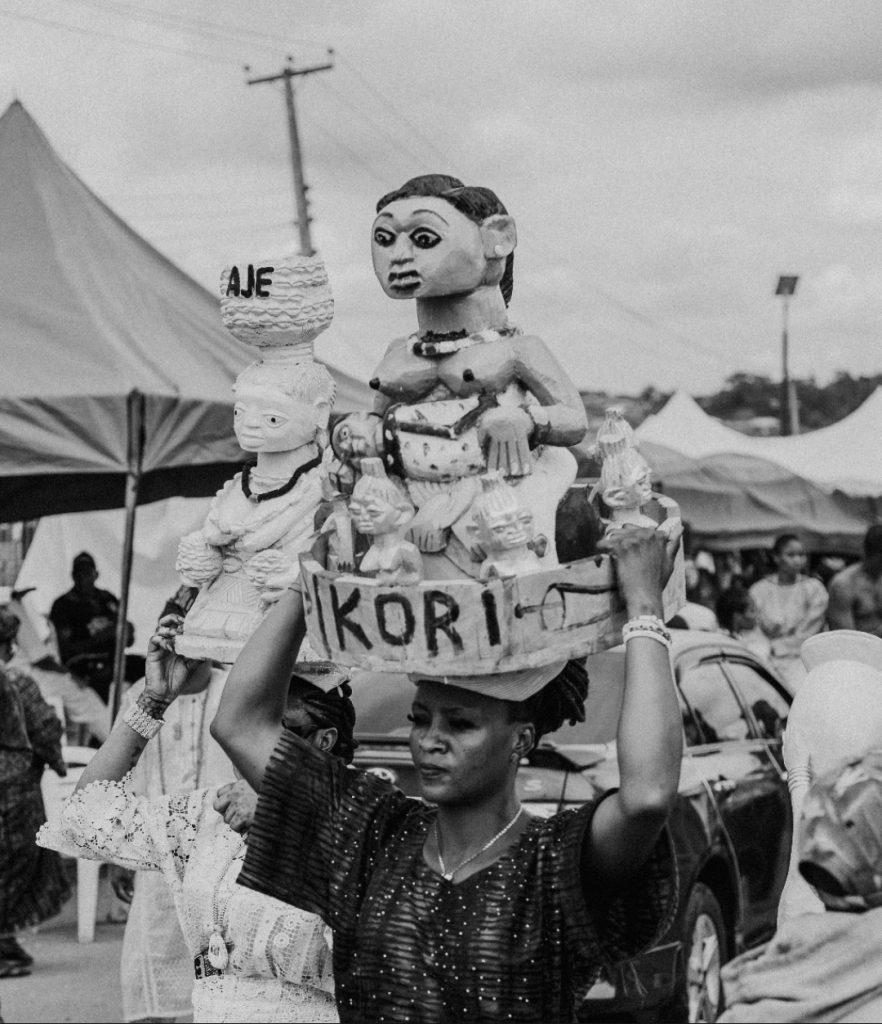
In his visual narratives titled Àwọn Obìnrin Tí Ń Gbé Òrìṣà, he depicts culture as a dynamic force, which is kept alive by the crucial roles women play generation after generation.
Embedded in the Yoruba cultural tradition, Àwọn Obìnrin Tí Ń Gbé Òrìṣà, which literally means “The Women Who Carry the Deities” symbolises cultural continuity and preservation through women as the main carriers and transmitters.
From his pieces, Adeife shows women as bearers of ancestral knowledge that naturally relate with deities, different generations of children and communities through various modes of socio-cultural interactions.
The work of Adeife revolves around the connection of cultural identity and heritage in relation to how history, memory and lived experience shapes emotional disposition.
The artist relocates culture from museum and secured places to public domain, where it can be seen in the streets, markets, under the bridges, amidst the movement of cars.
Through the artistic placement, Adeife demonstrates the connection of sacred rituals and communal activities.
In addition to documentation of historical events and lived experience, the artist utilises photography as a symbolic narrative device that creates images to investigate the survival of traditions.
From his works, it is clear that Adeife consciously connects various aspects of Yoruba traditional heritage with the present day society in order to show how the current lifestyles and urban setting allow for ritual practices, sacred objects and collective inheritance.
Àwọn Obìnrin Tí Ń Gbé Òrìṣà, translated, “The Women Who Carry the Deities” is a metaphor, expressing the message that women are indispensable. The artist concretises culture through the use of symbolic objects and sculptural representation of deities such as òrìṣà and other figures in the traditional religion and cultural events.
Some of the photographs capture women in a festive mood while celebrating communal activities and carrying physical objects.
Rather than seeing culture as static and inheritable, Adeife expands the metaphoric representation of culture to include kinetic symbols, identity and recollected memories. The characters are framed as carriers of stories, memory and culture.
Even though, each photograph captures a different aspect of cultural transmission, the interrelated nature of the frames creates coherent visual narratives.
Adeife captures mobile symbols and highlighted gestures to create rhythm, intimacy and emotional connection. The figures captured in the frame carry out activities such as walking, lifting of loads, balancing of objects like water pot on the head and carrying a physical weighty object. In each case, the activity is carried out by a woman.
The framing of women as carriers of culture and tradition reinforces the postulation made by Adeife on the cardinal roles of women as the lifeline of the society.
The artist frames five images in the narrative sequence, moving from an individual bearer to a group of women, from concrete and visible cultural objects to abstract and hidden ones and conveying memory as something that requires periodic renewal.
Intentionally, Adeife frames the images to demonstrate that heritage survives because it is carried along in the journey of life. Culture is not wished into existence neither is it the property of institution, traditional rituals or historical monuments. Through the pieces, the artist makes a case for women, emphasising their labour, sacrifices and endurance in receiving, preserving and transmitting culture.
The women are always there: They receive the culture from the past, live in the present and ensure its continuity beyond their generations as they transmit it to the next.
While emphasising photography as an integral element of inheritance, Adeife gives a new role to it by expanding its role beyond recording faces, events and times. As depicted in the piece, Ibi Ìrántí Alààyè that captures women in a procession, the artist frames photography as both a means of preservation of cultural elements and a form of that preservation and an aspect of the story.
Being integral to the visual narrative implies that the photographer does not control nor terminate a society’s culture. Photography becomes an active participant in the actions through the moments that encapsulate history.
Furthermore, the artist stylistically sculpts objects with rough surface and edges in order to bring out a feeling of imperfection. He presents handmade images with feathers like exaggerated faces and stylised bodies, showing that they are growing entities and not completed aesthetic objects intended for display in museums. Their relevance and meaning lie in the purpose they serve. While the images are handmade objects, they are brought to life as humans within their own community.
Àwọn Obìnrin Tí Ń Gbé Òrìṣà is rooted in the rich Yoruba cultural heritage. Adeife captures the concept of culture as an embodied, dynamic, mobile and functional being.
The work of Adeife captures the theme of continuity as demonstrated by the survival of identity, memory and culture from one generation to the another and the role played by individuals, especially women in the process.
Time in this body of work is presented as an unbroken chain. The past, present and future of the society are so interwoven that they cannot be separated. Through his portrayal of women as heroes, rather than victims of the society as most of the stories go, Adeife opens up fresh discussion on the cardinal roles played by women in building a sustainable society.



No comments yet. Start the conversation.