
•Oborevwori and Omo-Agege blow hot
For 26 years, every Delta governorship race had produced a fearless challenger, a bitter election and a courtroom finale. Today, the challengers are gone, the heavyweights have all moved into one party. What is left is a contest between a threat and an incentive.
By Egufe Yafugborhi
For 24 years, Delta State was Nigeria’s most reliable political theatre. Every governorship cycle produced same script: a powerful ruling party, a fearless challenger with a cult following, a bitter election, and a final act played out not at the polling unit, but in the courtroom.
Today, that theatre is eerily quiet. The gladiators are gone. The crowd has thinned out. And the man in the arena stands almost alone, almost unchallenged.
How did we get here?
The founding duel: Ibori VS Kragha
When democracy returned in 1999, Delta did not ease into politics. It exploded into it.
On one side stood James Onanefe Ibori of the Peoples Democratic Party (PDP) — charismatic, street-smart, and backed by a formidable political machine.
On the other stood Chief Frank Kragha of the All Peoples Party (APP) — a respected technocrat who represented the old Bendel establishment.
It was a keen race, but it set the template that would define Delta for a generation: The PDP as the party of power, and an opposition determined to prove that power could be challenged.
Ibori won. But Kragha’s challenge announced that Delta would never be a walkover state.
The age of Ogboru, the ‘People’s General’
If Ibori was the king, Great Ovedje Ogboru became the eternal rebel prince.
From 2003, Ogboru — first under the Alliance for Democracy, then the Democratic Peoples Party, and later Labour — turned opposition into a movement.
He was not just a candidate; he was a cause.
Market women in Warri, youths in Ughelli, fishermen in the creeks saw in him a man who refused to bow.
Three times he took the PDP to the tribunal.
Three times the elections were so close and so contested that victory was ultimately decided by judges, not just voters.
In 2007, the tribunal even annulled Emmanuel Uduaghan’s election, forcing a re-run.
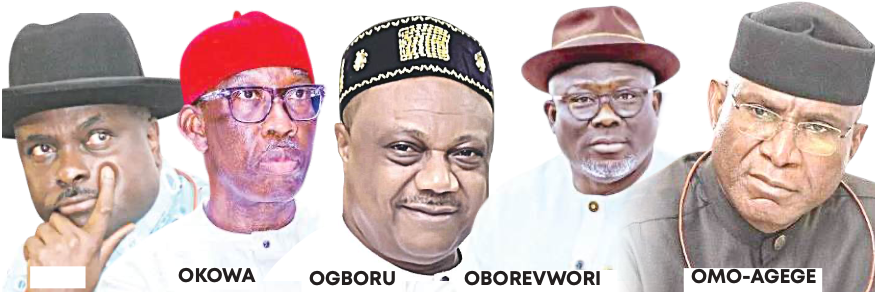
Ogboru never became governor, but he achieved something rarer: He made the PDP afraid of losing. Every governor from Ibori to Uduaghan and Okowa governed with one eye on Ogboru’s shadow. Opposition in Delta had a face, a voice, and a street army.
Last great battle: Omo-Agege VS Oborevwori
By 2023, the baton had passed. Senator Ovie Omo-Agege, Deputy President of the Senate and candidate of the All Progressives Congress (APC), mounted the most formidable challenge the PDP had faced since 1999.
He was not an outsider shouting from the streets; he was an insider, with federal might, resources and full weight of the ruling party at the centre.
His contest against Sheriff Oborevwori, then PDP candidate and anointed successor of Governor Ifeanyi Okowa, was brutal, expensive, and genuinely too close to call.
For months, Delta was split down the middle — Anioma VS Urhobo, PDP structure VS APC federal power, continuity VS change.
Oborevwori eventually won, but Omo-Agege had proved the old rule still held: In Delta, no incumbent could sleep soundly.
The twist that broke rule
Then came the great collapse. What happened to Ogboru in 2023 became a turning point in public perception.
After years of being the symbol of principled resistance, Ogboru conceded defeat to Oborevwori in a manner many of his supporters described as too quick.
To his loyalists, it felt like a betrayal.
The man who had once gone to court for them now appeared to have settled with the system he had fought.
Trust, once broken in Delta politics, is rarely repaired. Ogboru remains a candidate in name today, the followership — that fierce, almost religious loyalty — has evaporated.
He is now a reminder of what opposition used to be, not what it is.
At the same time, the ground shifted beneath Omo-Agege.
In April 2025, in what he tagged a “political tsunami,” Governor Oborevwori, his predecessor, Senator Ifeanyi Okowa, Deputy Governor, Monday Onyeme, the Speaker, federal and state lawmakers, council chairmen, and the entire PDP structure in Delta defected en masse to the APC.
It was the largest realignment in the state’s history.
The PDP, which had ruled Delta uninterrupted since 1999, simply ceased to exist as a ruling force.
It did not lose an election. It moved — lock, stock, and structure — into the party it had fought for eight years.
Omo-Agege had opposed the defection.
He lost that battle.
The newcomers, backed by Ibori and the presidency took over the APC structure he had built.
Today, Omo-Agege is not running for governor.
He is, by most accounts, focused on a return to the Senate, now under the Nigeria Democratic Congress (NDC).
The fiercest opposition figure of 2023 has been pushed to the margins of a party he once led in the state.
Anonymous opposition
This is the oddity in Delta today.
For the first time since 1999, there is no intimidating opposition candidate.
No Ogboru with a street army.
No Omo-Agege with federal backing.
No Kragha with establishment weight.
The reason, as many analysts now agree, is structural, not accidental: All the heavyweights ported to the APC. Ibori’s dynasty, Okowa’s machine, Oborevwori’s government, Emerhor’s old APC, Keyamo’s federal influence — all now sit, however uneasily, under one roof. The APC is no longer the opposition.
It is the state.
What is left outside is a PDP that is a hollow shell, a Labour Party without a local anchor, and a handful of smaller parties with candidates who lack name recognition, structure, or money.
Argument ends, threat begins
That is where the story turns dark.
Delta politics was once a war of ideas, however bitter. Ogboru argued about justice. Omo-Agege in 2003 argued about performance — he mocked perceived Oborevwori’s incompetence, questioned his paper credentials before the court said otherwise.
In 2026, that man is gone. Stripped of a party, stripped of a structure, stripped of the heavyweights who once stood behind him, Omo-Agege no longer has an army to argue with.
So he has reached for something else: Fear.
At a campaign stop in Uvwie on October 23, the former Deputy Senate President, now campaigning for Delta Central under the Nigeria Democratic Congress, looked into the crowd and detonated a phrase that has since refused to leave Delta’s political air: “Rig and die. I want to make the news again. Anybody who rigs the election on that day, we will kill him! If you don’t value your life, come and rig the election. They’re rigging your future. They’re rigging the future of your children. We’re waiting for them. Let them try it. It is rig and die. We’re going to give them aura for aura. There’s no court this time. We’re going to fight.”
His aides rushed to soften it. His media aide, Godwin Anaughe, insisted the warning was for riggers and ballot snatchers, not for ordinary voters.
But in Delta, where elections have bled before, words like that do not soften. They stick.
Consider the arc: The same man who once took his 2023 defeat to the tribunal, who once trusted judges to decide, now says there will be no court this time.
That is not a change of tactics. It is a confession of political bankruptcy — the admission that when you can no longer win the argument, you threaten the arena itself.
And across the divide, the governor has answered in kind, not with a rebuttal, but with a counter-lever.
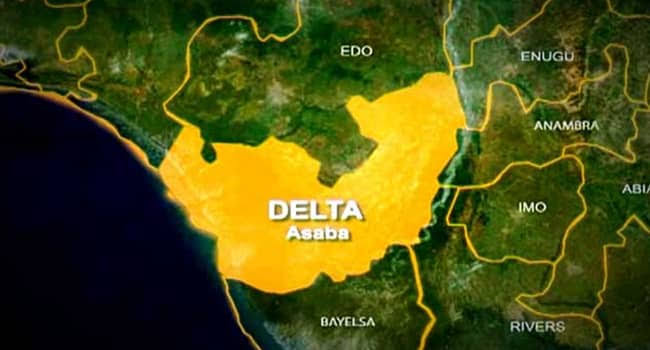
Oborevwori no longer needs to argue either. He has the state, the structure, and the payroll. So at the inauguration of the Delta APC Campaign Council in Asaba, where he unveiled ‘MORE Plus’ as his re-election theme, he turned welfare into a weapon.
Speaking to the very workers whose votes will decide 2027, he said: “You can’t collect 13th month salary and vote against APC.
“Today civil servants have no choice not to vote us. They have no choice. 13th month (salary) is huge, times two. Some people don’t understand what 13th month.
“What you’re receiving now is times two in December. “That is the meaning of 13th month. Whether you’re an appointee, whether a public servant, whether a civil servant, you’re receiving your 13th month.”
Five days later, on October 28, he signed it into law — the Thirteenth Month Salary Law, 2026. The irony was lost on no one in Asaba: 13th-month promise had been Omo-Agege’s own campaign pledge in 2023. Oborevwori had taken his rival’s best idea, funded it, legalised it, and then mortgaged it against the ballot.
It is a perfect, poisonous symmetry.
One man stands on a podium and says: If you rig, you die.
The other stands on a podium and says: If you eat, you must vote for me.
One threatens the body. The other buys the stomach. Neither is talking anymore about what Delta should become.
That is what happens when opposition dies. Politics does not become peaceful.
It becomes primitive. Without a credible challenger to force a debate on schools, hospitals, jobs, and the creeks, the contest collapses to its lowest instincts: Intimidation on one side, inducement on the other.
The Inter-Party Advisory Council (IPAC) in Delta has already condemned Omo-Agege’s “rig and die” outburst.
Labour leaders have hailed Oborevwori’s 13th-month law.
But neither condemnation nor celebration answers the deeper question: How did a state that once produced some of Nigeria’s most sophisticated political debates end up here — choosing between a threat and an enticement?
Victory without contest: Blessing or danger?
Is the prevailing atmosphere stability or stagnation?
On one hand, proponents of the defection argue that Delta has finally aligned with the centre, ending a drift into federal-state friction and opening the door to federal projects, appointments, and resources.
The old cycle of bitter litigation after every election is over.
On the other hand, Delta has lost something precious: The discipline of fear.
From 1999 to 2023, governors in Delta performed — or at least tried to — because they knew Ogboru was waiting, or Omo-Agege was coming.
Opposition was the state’s unofficial accountability mechanism. Without it, there is no one to force the incumbent to explain a bad road, a failed school, or a bloated budget.
The irony is profound. Delta did not become a one-party state because the opposition was defeated at the polls. It became one because the opposition and the ruling party decided to become the same party.
Ogboru lost his revolt. Omo-Agege lost his party. The PDP lost its soul. And Oborevwori, almost by default, inherited a state where his biggest challenge in 2027 may not be another candidate, but the internal contradictions of the giant APC coalition he now leads.
Delta’s politics has travelled a full circle. It began in 1999 with two men fighting for a new state. It rose to a crescendo with Ogboru’s people’s revolt and Omo-Agege’s federal assault.
It has now arrived at a strange quiet — not the quiet of peace, but the quiet of a stadium after the gladiators have all left to join the same team.
The question for 2027 is no longer – Who will challenge Oborevwori? It is who will hold him accountable if no one does?
And with “rig and die” echoing from one podium and “13th month salary” echoing from the other, Deltans must now ask a darker question: When politics stops being about ideas, what is left except intimidation and incentive?
History suggests Delta never stays quiet for long.



No comments yet. Start the conversation.