
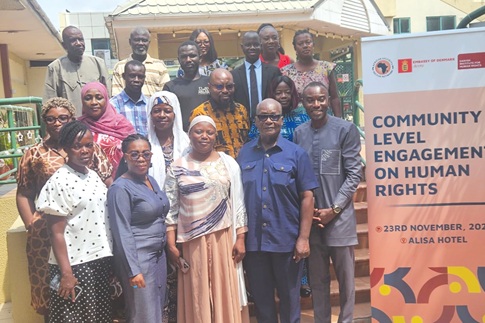
A Deputy Director at the Ministry of the Interior, Gifty Quaye, has called for a standardised, practical and sustainable human rights training manual with clear ownership and measurable results for the Ghana Police Service.
That, she said, was very relevant to the country’s continuing efforts at strengthening democratic governance, professionalism, accountability and public confidence in security institutions.
Ms Quaye said this at the opening of an engagement with community members in Accra yesterday (November 23, 2026).
Organised by the African Security Sector Network (ASSN) with support from the Danish Institute for Human Rights (DIHR), the community engagement comes on the heels of a similar event with representatives of the security services.
The meeting brought together representatives from community watchdogs, market women and other members of the public.
Human rights
Ms Quaye said human rights were cardinal to the very tenets of human existence and therefore human rights protection was an essential component for effective policing.
“Chapter 5 of the 1992 Constitution and the country's laws are geared towards the protection of fundamental rights, including the right to life, education, association and freedom of speech,” she pointed out, adding that how the police handled those responsibilities had a direct bearing on public confidence in the service and in the country as a whole.
Ms Quaye said a professional police service must, therefore, not only protect life and property, maintain law and order and prevent and detect crime, but also exercise those powers within the law and with due regard for human dignity, rights and freedoms.
She, therefore, urged everyone to speak freely but constructively, adding that there are no lesser contributors.
Reforms
A Senior Member of the African Security Sector Network (ASSN), Major General Carl Coleman (retd) said reforms in the security sector must be designed, led and owned by the respective jurisdictions.
He said security sector reform would fail if it was imported, imposed or written only by experts.
In that regard, Major General Coleman said the manual must be informed by broad and inclusive consultations, so that it would be practical, relevant, responsive and address the needs of all relevant groups.
Trust
The Project Lead, Dr Emmanuel Sowatey, for his part, pointed to what police scholars called the “legitimation problem”, which he explained was the issue of trust and confidence between the police and the people they served.
That trust, he said, was not uniform since the experience of people varied from one community to another.
“The experience of an older generation will differ from that of a younger generation, because of different levels of social capital and different histories with the police.
Young people, in particular, may have very different encounters with officers depending on where they live, how they dress, and how they are perceived,” Dr Sowatey indicated.
He said policing was not guesswork but a science that needed evidence, adding that evidence-based policing was at the heart of contemporary policing.
“Every police institution in the world complains of limited resources, be it human resources, vehicles, logistics, funding, but evidence allows the police to deploy what they have to where it is most needed, so that both the state and the public benefit,” he stated and said evidence was not only about resources but also about trust.



No comments yet. Start the conversation.