
By Tunde Oso and Precious Enaike
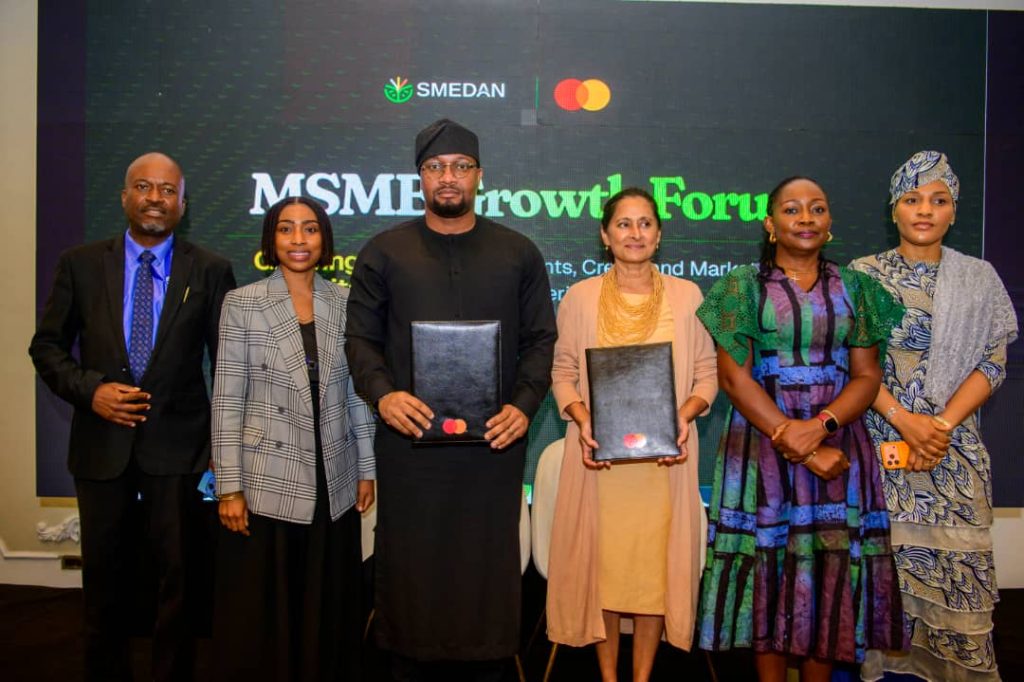
Mastercard and the Small and Medium Enterprises Development Agency of Nigeria (SMEDAN) have signed a Memorandum of Understanding (MoU) to strengthen the digital capabilities of Nigerian small and medium-sized enterprises (SMEs), improve business efficiency and expand their participation in the digital economy.
SMEDAN is an agency under the Federal Ministry of Industry, Trade and Investment.
The agreement, announced at the SMEDAN MSME Growth Forum, establishes a framework for both organisations to explore initiatives that will equip small businesses with digital tools, practical skills and the support required to achieve sustainable growth.
The partnership aligns with the Federal Government’s digital economy agenda and builds on the Federal Ministry of Industry, Trade and Investment’s support for the design and piloting of a national MSME Digitization Programme.
The initiative is expected to promote the adoption of digital solutions among Nigerian entrepreneurs, enhance operational efficiency and encourage the transition of informal businesses into the formal economy.
Speaking at the forum, Executive Vice President, Growth Segments, Mastercard, Tara Nathan, emphasised the critical role of small businesses in driving economic growth, job creation and innovation.
She noted that despite their contributions, many entrepreneurs still face significant barriers to digital adoption, skills development and access to finance.
According to Nathan, the MoU provides a framework through which Mastercard and SMEDAN can explore opportunities to equip Nigerian entrepreneurs with the tools, capabilities and connections needed to build resilient businesses and benefit from the opportunities of the digital economy.
Also speaking, Director-General of SMEDAN, Charles Odii, stressed that Nigerian entrepreneurs require more than encouragement to embrace digitalisation, noting that they need practical solutions, relevant skills and accessible support systems that address the realities of operating small businesses.
He said the collaboration would provide an opportunity to bring these capabilities closer to businesses while strengthening engagement with government and other ecosystem stakeholders.
Similarly, Country Manager, West Africa, Mastercard, Kari Tukur, explained that supporting SMEs requires a comprehensive approach beyond access to funding.
She identified digital payment solutions, business skills, market access and reliable partnerships as essential factors for enabling entrepreneurs to grow sustainably and remain competitive.
Tukur added that the MSME Growth Forum was designed to bring together stakeholders to discuss practical solutions to the challenges confronting Nigerian businesses, while reinforcing Mastercard’s commitment to supporting entrepreneurship and economic inclusion.
The forum also featured a keynote address by Nathan and a fireside conversation with Aisha Rimi, Executive Secretary and Chief Executive Officer of the Nigerian Investment Promotion Commission (NIPC).
The discussion, themed “Informal to Inclusive: Payments, Policy and the Path for Nigeria’s Small Businesses,” examined how digital payments, supportive government policies and public-private partnerships could help informal businesses transition into the formal economy and unlock new growth opportunities.
Another major highlight was a panel session titled “Beyond Credit: The Solutions Nigerian SMEs Need to Grow and Scale.” The session featured representatives from Access Bank, Wema Bank, AFEX and SMEDAN, with Tukur serving as moderator.
Discussions focused on the need for a broader support ecosystem for SMEs, highlighting the importance of financial inclusion, digital infrastructure, capacity development and access to markets, rather than relying solely on traditional credit facilities.
Beyond the policy and industry conversations, participating entrepreneurs benefited from practical masterclasses aimed at strengthening their business and digital capabilities.
The training sessions covered digital marketing strategies for attracting and retaining customers online, as well as sector-specific solutions, particularly in agriculture, to improve productivity, expand market access and promote sustainable business practices.
The partnership comes against the backdrop of increasing recognition among Nigerian SMEs of the importance of digital transformation to business growth.
Findings from Mastercard’s 2026 SME Confidence Index revealed that 100 per cent of Nigerian SMEs surveyed consider digital and online payments essential to growing their businesses.
The report further showed that 78 per cent of the businesses identified digitalisation as a major priority, while 79 per cent prioritised staff training and upskilling. Additionally, 69 per cent indicated that they were seeking credit to expand their operations.
The findings underscore the growing demand for digital solutions, workforce development and financing opportunities among Nigerian entrepreneurs.
Through the MoU and the MSME Growth Forum, Mastercard and SMEDAN are seeking to strengthen collaboration among government institutions, financial organisations, business leaders and entrepreneurs to develop practical solutions that will improve SME competitiveness.
The partnership is expected to contribute to building a more digitally enabled, inclusive and resilient MSME sector, positioning Nigerian small businesses to take advantage of emerging opportunities in the country’s evolving digital economy.




No comments yet. Start the conversation.