
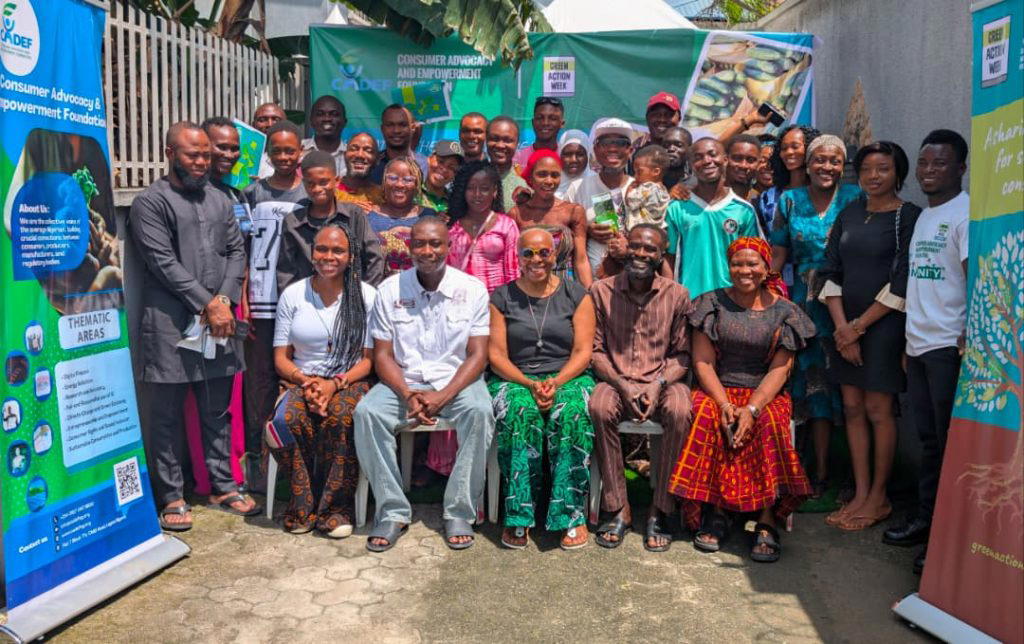
…Participants grow vegetables in sacks, buckets, other household containers
By Juliet Umeh
The Consumer Advocacy and Empowerment Foundation (CADEF) says it has trained 125 people in small-space food production through its Green Living Initiative, a community project aimed at helping households grow crops with readily available and reusable materials.
The initiative, which ended in Lagos on Saturday, used a train-the-trainer model. CADEF initially trained 25 participants, who then passed on their knowledge to others in their communities.
The project was supported through the Green Action Fund, funded by the Swedish Society for Nature Conservation and administered by Consumers International. It was held under the 2026 Green Action Week theme, “Sharing Community.”
The programme comes amid persistent concerns about food affordability. The National Bureau of Statistics reported that food inflation stood at 19.59 per cent year-on-year in September 2026, meaning food prices remained higher than a year earlier despite a slowdown in the monthly rate of increases.
At the closing ceremony, participants and Green Living Ambassadors displayed their produce and demonstrated sack and container gardening. They also showed how window boxes, empty oil kegs, discarded paint buckets and other underused spaces could be used to grow crops, including okra, cucumber, sweet potato, tomato and groundnut.
CADEF’s Executive Director, Prof. Chiso Ndukwe-Okafor, said the programme gave households practical skills they could use with the space and resources available to them.
“Food prices affect what families can afford to put on their tables. We recognise that small-space gardening cannot, on its own, solve the problem of food inflation, but it can give households another option,” she said.
“If someone can use a sack, an old bucket or a small space at home to grow vegetables, that is valuable knowledge. The next step is to put that knowledge to use and share it with others.”
Ndukwe-Okafor said the train-the-trainer approach helped extend the project’s reach beyond the first 25 trainees. She urged participants to continue gardening after the programme and share their skills with others.
She cited the example of a young man who, she said, grows yams in about 100 sacks in his compound, sells some of his harvest and uses the proceeds to pay his children’s school fees.
“His experience demonstrates what is possible when people apply the knowledge they have acquired. I encourage all our participants not to stop because this programme has ended. Keep growing, keep learning and, importantly, share what you have learnt with others,” she said.
The Deputy Director of Agriculture at the Lagos State Ministry of Agriculture and Food Systems, Ms Olufunke Obafemi, commended CADEF’s consumer education and advocacy work.
“We recognise the importance of promoting sustainable agricultural practices, reducing food loss and waste, and encouraging responsible consumption,” she said. “These efforts are important to strengthening our food systems and protecting livelihoods.”
Obafemi said the ministry remained committed to initiatives linking environmental sustainability with agricultural development, food security and public well-being.
One participant, Chibueze Nwachukwu, said the training had given him the confidence to begin growing food at home.
“Three months ago, I wasn’t confident or knowledgeable about growing my own food. With the support from CADEF and the facilitators, I have now been able to grow groundnuts, and I plan to try other crops soon,” he said.
CADEF said it hoped participants would continue cultivating food and sharing their knowledge beyond the formal end of the project.
The organisation works on consumer rights, public health, safety, accountability and sustainable consumption through research, advocacy, public education and policy engagement.




No comments yet. Start the conversation.