
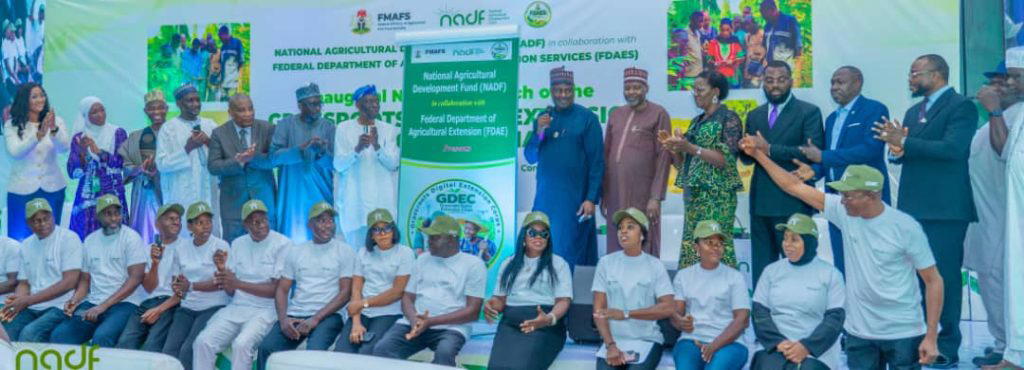
….trains 1,884 extension agents, food security specialists
By Gabriel Ewepu
ABUJA – IN a bid to galvanize food production, the Federal Government, Wednesday, launched a digital agricultural extension initiative, tagged the Grassroots Digital Extension Corps, GDEC.
Also trained 1,884 extension agents food security and specialists (1,110 agricultural extension agents and 774 food security specialists) in the 36 states and the Federal Capital Territory (FCT).
Basically, they are to upscale farmers’ technical knowledge, improve productivity, and reduce and gap between agricultural research and farm-level application.
The Minister of State for Agriculture and Food Security, Senator Aliyu Abdullahi, explained the essence of the initiative is to tackle poor yields from the farms and unlocking the nation’s agricultural sector estimated $300 billion economic potential.
According to Abdullahi, despite agric sector’s contribution of about 26 per cent to Gross Domestic Product, GDP, and employed over 70 per cent of the population across different segments of the value chain, the sector has contributed only about $1 billion to the country’s foreign exchange earnings.
The Minister emphasised that extension services must go beyond advising farmers on planting techniques to providing market-oriented information that connects production with industry requirements.
He noted the enormous potential of the sector to significantly generate higher revenue and contribute about 30 per cent to President Bola Tinubu’s $1 trillion economy vision, translating to approximately $300 billion.
However, the Minister of State strongly emphasized that achieving the target would require a knowledge-driven agricultural system supported by skilled personnel and effective extension services.
He also expressed concern over Nigeria’s dwindling agricultural productivity compared with other African countries, hence the urgent need to take farmers’ access to technical knowledge to greater heights through improved production practices.
According him (Abdullahi), while yields for several Nigerian crops remained between 1.3 and 1.5 tonnes per hectare, African countries including Egypt recorded about 11 tonnes per hectare under irrigation.
He also pointed out that amid the euphoria about Nigeria remaining the world’s largest cassava producer with an estimated output of 63 million metric tonnes annually, an average yield of six to seven tonnes per hectare remained below its potential.
Meanwhile, he expressed optimism that improved extension services could help farmers increase yields, reduce production costs and explore opportunities in industrial processing, including high-quality cassava flour and other value-added products.
He said, “If your extension services and advice to me is not market-centric, you are just deceiving the farmer. You are wasting his time and discouraging him.”
He said it is imperative to have the GDEC integrated with the Ministry’s existing National Electronic Extension Platform (NEEP), to avoid duplication of efforts and conflicting agricultural information.
He proposed a ministerial-level committee to harmonise existing initiatives into a unified national agricultural extension delivery system, and called on the National Assembly to reconsider the proposed Agricultural Extension Bill.
Earlier, the Executive Secretary, NADF, Mohammed Ibrahim, explained that the GDEC was developed in partnership with the Federal Department of Agricultural Extension and other stakeholders to address the gap between agricultural research and its practical application.
Ibrahim further stated that the programme was built around three critical components: people, tools and data, adding that it would also generate field-level information to help government design evidence-based agricultural interventions.
He expressed confidence about the success of the initiative, and emphasized that the initiative would be measured not by the number of agricultural extension personnel trained or digital tools distributed but by the number of farmers reached, adoption of improved practices and measurable productivity gains.
Also speaking, the Director of the Federal Department of Agricultural Extension, Engr Taiye Tehinse, said digital platforms such as FarmEasy would complement conventional extension approaches by improving communication, data collection and agricultural decision-making.
He said the trained personnel must possess both digital skills and practical agricultural competencies to provide quality advisory support, while calling for the inclusion of women, youths and persons with disabilities in digital agricultural programmes.
In her remarks, the Head, Policy and Advocacy, NADF, Yejide Olarinde, identified the shortage of extension personnel as a major obstacle to agricultural development.
Olarinde disclosed that Nigeria had an extension agent-to-farmer ratio of approximately 1:10,000, colmpared with the Food and Agriculture Organisation’s recommended ratio of one extension agent to 1,000 farmers.
She also pointed that the disparity had restricted farmers’ access to timely information on improved production practices, climate-smart agriculture, soil management, appropriate input utilisation, pest and disease control and market opportunities.
She described extension agents as farmers’ best friends, stressing that their responsibility was to translate research findings and innovations into practical solutions that would improve agricultural productivity and livelihoods.
She added that GDEC would help ensure that relevant agricultural knowledge reached farmers at the grassroots and translated into measurable improvements in production.



No comments yet. Start the conversation.