
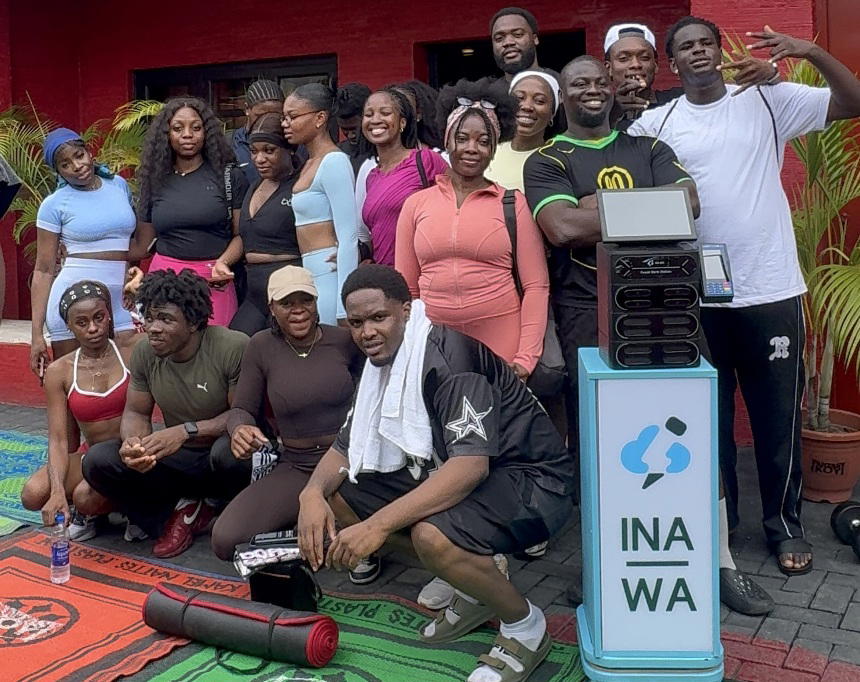
Adenijo Bello spent years managing musicians. The job was logistics under pressure: getting people to the right stage, on time, with everything working. Then the founder noticed something nobody in the green room was planning for. The audience’s phones were dying.
Anyone who has stood in a Lagos crowd late at night knows the scene. The headliner walks on, a thousand screens go up, and before long the screens start going dark. People who were filming a minute ago are now hunting for a socket, or for a friend with a power bank, or for any way to book a ride home before the battery gives up.
“At every show, people were filming, tagging and calling rides until the battery gave out,” Adenijo says. “Nobody had solved it properly.”
That observation became INA-WA, a power bank rental service running from booths at Lagos events, malls and transport hubs. The company is less than a year old, and the idea did not start in a boardroom. It started in the middle of the problem.
Skills that travel
The move from music management to a tech-adjacent business is less strange than it sounds. Managing artists teaches you the things startups need: reading a crowd, negotiating with venues and promoters, and understanding that an experience only counts if it works on the night. A show has no second take. Neither does a phone that dies at the wrong moment.
Lagos has no shortage of founders who arrive from finance, consulting or engineering. Adenijo arrives from the entertainment side of the economy, where margins are thin, schedules are brutal and reputation travels faster than any press release. That background shapes a culture of showing up, which partners tend to notice.
Adenijo says the event world gave INA-WA its first customers and its first distribution.
“Promoters already trusted me. They knew I would show up and deliver.” That trust matters when hardware has to sit in somebody else’s venue, on somebody else’s night, under somebody else’s brand. A promoter who has worked with a manager for years will give a new service a chance. A stranger with a pitch deck rarely gets the same welcome.
Borrowing a national memory
The brand also borrows from the culture the founder came from. INA-WA’s identity draws on “Up NEPA,” the shout that once met every restored power supply in a Nigerian neighbourhood. NEPA, the National Electric Power Authority, was replaced by PHCN in 2005, yet the name never left everyday speech. Nigerians still say it when the lights come back.
The company turns that shared memory into marketing. Its social presence runs on music, nostalgia and humour, the language of the audience it serves, and not on corporate jargon. The result is a brand that feels less like a utility and more like an inside joke Lagos already knew. For a founder who spent years around artists, the instinct is familiar: build something people want to talk about, not just something they use.
The unglamorous part
Running a hardware-plus-service business in Lagos is hard, and Adenijo doesn’t hide it. booths must be stocked and charged. Devices must come back. Payments must work at the point of sale. “A song can fail and you release another one,” Adenijo says. “A power bank that doesn’t come back is a real loss.”
That difference explains much of how the company operates. A music release is a bet on taste. A rental fleet is a bet on discipline: tracking each device, staffing each kiosk, and making sure the next customer finds a charged unit. INA-WA is also pushing for better card pre-authorisation support, the mechanism that lets a business hold funds against a rental so that a lost device does not become a lost cost. It is not the kind of problem that earns applause on a stage, but it decides whether the business survives.
Two ways to pay
INA-WA sells to event hosts in two ways. Under an event package, the host pays a flat fee and guests charge without paying. Under guest-pay, the host pays a setup fee and guests pay for their own charging time.
The structure lets a promoter with a tight budget and a promoter with a premium crowd both say yes, and it gives the company two routes to the same kiosk.
Early numbers, long horizon
Still, the early numbers point somewhere. INA-WA reports 10,000+ users and 100+ events served in under a year, among them Amapiano District, Lagos Trivia Night, Somewhere Sunny and Sandy, Jaiye on the Beach and PM2AM. The next step is more locations and more partners. The company sees the long-term business as energy access for a young population.
A first year of events is a promising start, but it does not settle the harder questions: whether customers come back, whether devices keep returning, and whether the model works in a mall at noon as well as it does at a concert at midnight. Those answers will come from operations, not from press coverage.
“I came from an industry where you learn quickly that audiences decide,” Adenijo says. “I’m building the same way.”
In a city where a power cut can still end an evening early, a founder who learned the trade backstage is betting that the next service to win Lagos will be the one that keeps the night going.



No comments yet. Start the conversation.