
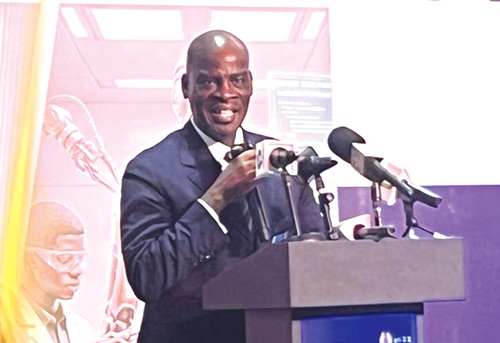
The Ministry of Education has warned that henceforth, any pupil who registers to sit the Basic Education Certificate Examination (BECE) ahead of time will be banned from writing the examination for two years.
“Effective immediately, from today, any Ghanaian child who leaves early to write will be banned from taking the same examination.
“If a child is in basic education, junior high school (JHS) Two or JHS One pupil, who decides to graduate himself to JHS Three and write the BECE, that child will be banned for two years from sitting the same exercise.
We are doing this to instil discipline and to allow for the purpose of effective planning so that we know that every year, this is the total number of students expected to graduate from BECE and not the numbers that we have witnessed,” Mr Iddrisu stated at the opening of this year’s Education Week.
The two-day event, which is on the theme: “Harnessing artificial intelligence for inclusive and transformative education in Ghana,” is being attended by stakeholders in the education sector, the various agencies under the ministry, academia and donor agencies.
The celebration seeks to create a platform for policymakers, teachers and other stakeholders to explore how artificial intelligence can improve teaching and learning in Ghana.
Mr Iddrisu observed that some parents forced their children to go ahead of others, adding, “That is not equity and, therefore, Director General, I expect you to act.”
Improving learning
Touching on the theme, the Education Minister said Ghana’s ambition on artificial intelligence (AI) was not just to introduce it into classrooms, but to use it to harness AI to improve learning outcomes and expand educational opportunities, and to develop human capital that could compete with the rest of the world in a rapidly changing technological world.
He questioned how ready and how prepared Ghanaians were, as a country, to be able to adopt AI, adding, “We are reminded that the rapid diffusion of AI in the economy raises new challenges for governments and education stakeholders.”
“So, as a country, how are we positioning that, and how are we positioning our educational system to make ethical, responsible use of AI,” Mr Iddrisu further asked.
The Education Minister stressed that education must apply the knowledge and skills to deliver on the present vision, stressing that it was in that direction that, “we are already working as government to revise curriculum from kindergarten to primary school.”
AI as a tool
Mr Iddrisu said AI must become an instrument for closing educational gaps, saying that the way forward now was how to ensure that AI was used to expand access to quality inclusive education.
He assured teachers that the government policy was to empower teachers with technology, not replace teachers with technology.
“So, our teachers in this room, don't be afraid that the government of Ghana will employ technology in the name of AI to replace you.
“It will only complement your efforts and characterise them and develop critical minds,” he assured teachers.
Civil societies
Presenting the position of the role of civil society in education, the National Coordinator, Ghana National Education Coalition Campaign, Bernice Mpere-Gyekye, said: “We welcome the focus of artificial intelligence in Ghana education agenda. We commend the government and the Ministry of Education for opening the important national conversation.”
She said the position of the coalition had been for Ghana to embrace AI, but technology must serve education, not dictate its priorities.
Mrs Mpere-Gyekye said the measure of success must be improved learning, stronger teaching, reduced inequality and greater opportunity for every learner.
In an address, the Deputy Minister of Education, Dr Clement A. Apaak, reaffirmed the government’s commitment to integrating AI and digital tools into the national school curriculum to equip Ghanaian students for an increasingly interconnected world.
He said the government was focused on using emerging technologies to enhance teacher effectiveness and improve learning outcomes.




No comments yet. Start the conversation.