
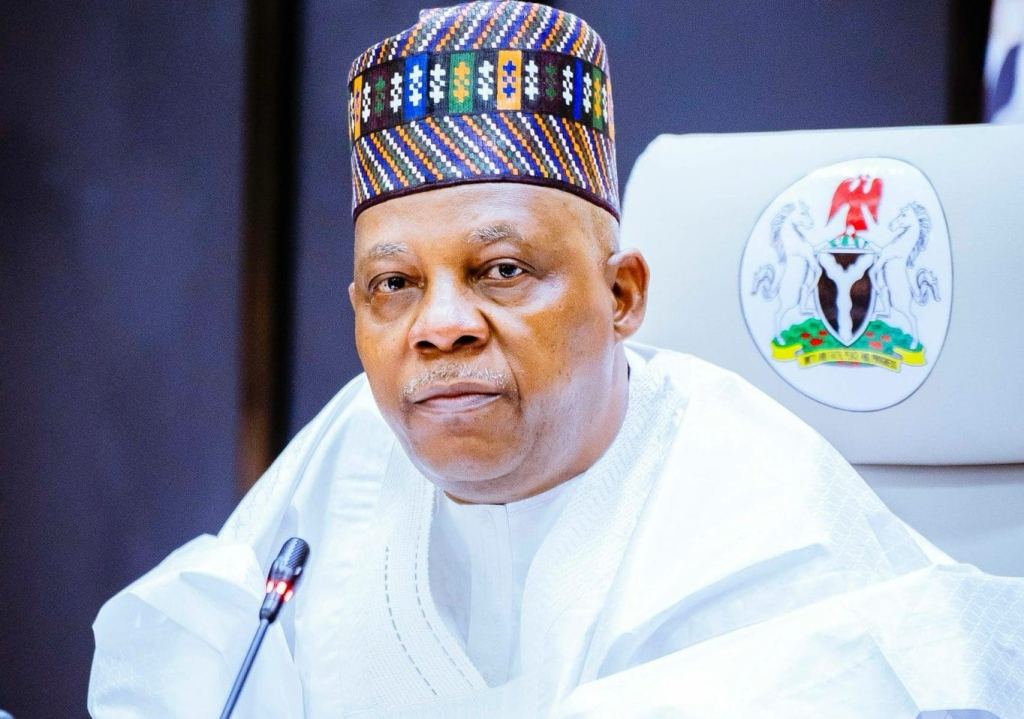
The Nigerian Democratic Congress, NDC, has urged Vice President Kashim Shettima to focus on addressing the realities facing Nigerians, and not statistics.
According to NDC, the obsession of the All Progressives Congress, APC-led government with attacking the NDC candidate, Mr Peter Obi, for citing statistics “is both troubling and revealing”.
The party urged APC to confronting the evidence Obi presents about Nigeria’s worsening economic and social conditions with facts and numbers, and not “attack the messenger, as well as throwing cheap shots that do not address the real issues”.
NDC’s position was made clear in a statement by Dr. Chiogo Ikokwu, spokesperson, NDC National Campaign Council.
NDC said: “Statistics are not insults. They are not political weapons. They are tools for measuring progress, exposing failure and guiding public policy. A government that is confident in its performance should welcome scrutiny, not wage war against the numbers.
“The shame is in presiding over worsening conditions while refusing to learn from countries that have made measurable progress, using Peter Obi’s model. Nigerians are going through harrowing times and numbers don’t lie. Let’s look at a few.
“Petrol rose from an average of N238.11 per litre in May 2023 to between N1,300 and N1,435 per litre in 2026. Fifty kg bag of rice climbed from roughly N35,000 to N40,000 in mid-2023 to between N50,000 and N90,000+ in 2026, depending on the brand and market.
“Fifty kg bag of cement increased from roughly N4,010 to N5,300 in 2023 to between N10,500 and N15,000 in 2026. Loaf of bread more than doubled from N500 to N700 in 2023 to N1,200 to N2,000 in 2026. Urban house rent increased by an estimated 80% to 120% in major cities such as Lagos and Abuja.
“If the government disagrees with Mr Obi’s figures, let it publish credible data, explain its methodology and demonstrate where his analysis is wrong. You do not defeat statistics by insulting the person who cites them. You defeat them with better statistics.
“This is precisely why Mr Obi’s insistence on evidence, measurable outcomes and learning from successful economies matters. Governance must be about results, not excuses; measurable progress, not propaganda; and the welfare of citizens, not the protection of political reputations.
“Let’s examine other countries that could be peers. It’s a fact that Bangladesh is a developing country with a population of about 178 million people while Nigeria has over 200 million people. It is a verifiable statistic that Bangladesh achieved significant poverty reduction between 2010 and 2022 lifting about 34 million people out of poverty which reduced extreme poverty rates from 12.2% to 5.6%.
“It is also widely known and confirmed that the significant poverty reduction was achieved through five key pillars- Agricultural growth, Export-oriented manufacturing, microfinance and NGOs, Social Safety Nets and Human Capital/Infrastructure.
As the above pillars through which Bangladesh significantly reduced poverty are not too difficult to understand, the appropriate thing a patriotic and effective government would have done is to humbly and diligently learn to see how Nigeria can also significantly reduce our embarrassing and shameful poverty level.
“Moreover, just as it is in Bangladesh, so it is of the remarkable leadership in Vietnam, Rwanda, Morocco, India and many other developing nations.”




No comments yet. Start the conversation.