
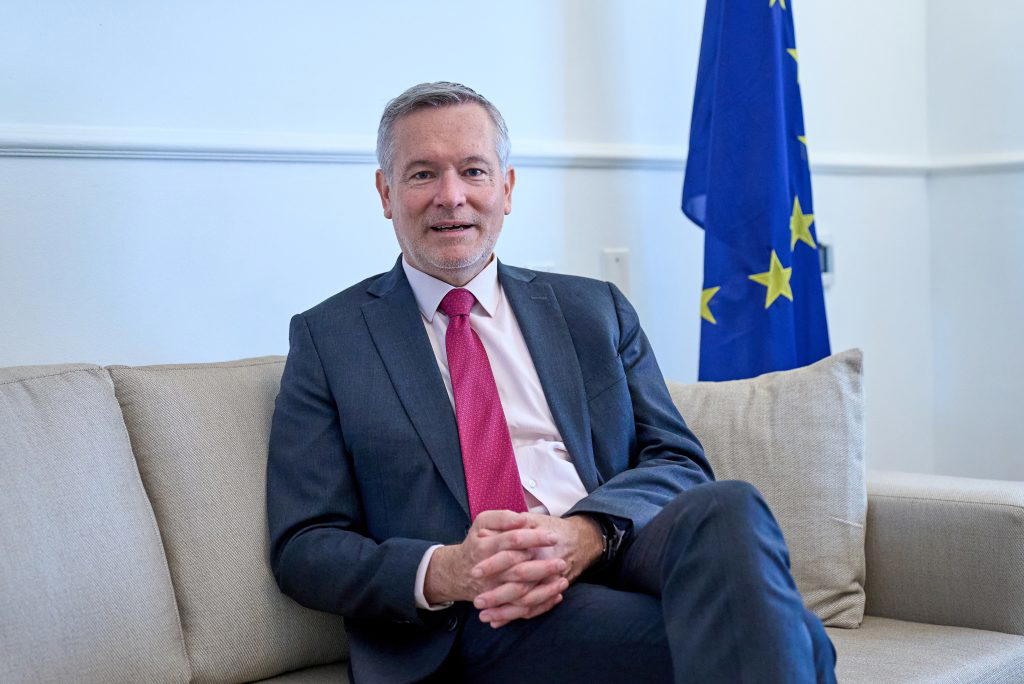
The European Union (EU) Ambassador to Nigeria and ECOWAS, Gautier Mignot, has described Nigeria as central to Europe’s expanding cultural engagement with Africa, saying the bloc is seeking to deepen cooperation in the creative industries, digital infrastructure, youth employment and democratic governance ahead of the 2027 general elections.
Mignot stated this in an interview with Vanguard ahead of the 2026 Lagos Biennial, scheduled to hold from November 14 to December 6 at Heliconia Park, Eko Atlantic, Lagos.
He said Nigeria, particularly Lagos, immediately came to mind when the EU began considering a major cultural initiative in Africa, describing Lagos as one of the world’s major cultural centres with strong appeal to younger audiences.
The fifth edition of the Lagos Biennial, themed The Museum of Things Unseen, will feature the EU Pavilion, titled Together, with exhibitions exploring Ukrainian artistic experiences during the war and the possibilities of digital creativity and audience participation.
Mignot said the EU’s participation would go beyond financial sponsorship, as it would bring exhibitions from Europe to Nigerian audiences and contribute directly to the Biennial’s artistic programme.
He explained that the pavilion’s message of togetherness reflected the EU’s broader ambition to build a lasting relationship with Nigeria through cultural exchange, mutual learning and collaboration.
The pavilion will feature two exhibitions: Home Beyond the Dawn, an immersive digital exhibition featuring contemporary Ukrainian artists creating amid the war, and The Future is Shared, which explores digital creativity and offers audiences opportunities to participate in the creative process.
According to the ambassador, the exhibitions are intended to expose audiences to experiences that are often overlooked and demonstrate how art can encourage dialogue in a world increasingly affected by conflict, polarisation and uncertainty.
“Culture creates opportunities for dialogue, and we desperately need dialogue in an increasingly polarised world. It also brings hope and encourages us to think about solutions for the future,” he said.
Mignot maintained that supporting culture was not a distraction from global challenges, but part of the response to them, particularly because artistic expression, democracy and freedom of expression were values shared by Europe and Nigeria.
Beyond the Biennial, he said the EU was creating funding opportunities for cultural cooperation across sub-Saharan Africa through the Africa-Europe Partnerships for Culture, which supports partnerships between African and European cultural institutions and creative professionals.
He identified artistic co-creation, mobility and audiovisual co-production as areas of support, noting that Nigeria was one of the programme’s priority countries.
The ambassador also linked the EU’s cultural ambitions to its wider Global Gateway investments, particularly in digital infrastructure, which he said could create new opportunities for artists, filmmakers, content creators and entrepreneurs.
He cited the EU’s support for the Federal Government’s Project BRIDGE, which aims to roll out 90,000 kilometres of fibre-optic infrastructure across Nigeria to improve connectivity, including in underserved and remote areas.
According to him, improved internet access would create opportunities for creative professionals to produce and distribute content, collaborate and reach wider audiences.
“Today, artists, filmmakers, content creators and other creative professionals increasingly depend on digital technology to produce their work, collaborate, distribute content and reach audiences,” Mignot said.
He said the benefits of infrastructure investment should also be considered in terms of the opportunities such investments create for people and businesses.
On the wider impact of EU–Nigeria cooperation, Mignot said the bloc was preparing a communication campaign to highlight young Nigerians working in education, the digital economy, renewable energy and other areas of economic and social development.
He said the campaign would present Nigerians not merely as beneficiaries of development assistance, but as active partners and leaders using available opportunities to develop their potential and help others grow.
Young people and women, he added, remained central to the partnership, both through targeted programmes and their inclusion in wider investments.
One example is the Nigeria Jubilee Fellowship Programme, supported by €44 million in EU funding and implemented by the United Nations Development Programme in partnership with the Federal Government and private sector organisations.
Mignot said the programme was designed to help young graduates gain their first professional experience through one-year placements in organisations, including private companies, thereby improving their prospects of entering the labour market.
He also identified programmes supporting women’s empowerment and protection, including efforts to address sexual and gender-based violence, as well as financing arrangements through European financial institutions to improve access to credit for businesses led by women and young people.
Turning to the 2027 general elections, the ambassador said there were considerable expectations in Europe, Africa and around the world for Nigeria to demonstrate the strength of its democracy.
He said the EU was supporting electoral preparations through its EU-funded Support to Democratic Governance in Nigeria programme, which works with institutions and stakeholders including the Independent National Electoral Commission, civil society organisations, political parties, the National Assembly and the media.
Mignot also confirmed that the EU would deploy an Electoral Expert Mission for the elections, adding that the bloc would pay particular attention to the need for a genuine level playing field, peaceful campaigns and the safety of candidates and voters.
“All political forces and candidates must be able to participate freely and safely in the electoral process. There must be space for political expression, and electoral campaigns should take place without violence or intimidation,” he said.
He specifically stressed the importance of ensuring that women candidates could campaign and express themselves freely and safely, while voters must be able to exercise their democratic rights without fear.
However, he said the EU recognised its position as a partner and external observer, insisting that it would not impose decisions on Nigeria and would respect the country’s sovereignty. He added that any electoral disputes must be resolved by Nigerians through their own institutions.
Looking beyond the Biennial, Mignot said he hoped the EU’s relationship with the event would continue beyond the 2026 edition, rather than remain a one-off cultural initiative.
He said Europe’s ageing population and Nigeria’s youthful population, alongside their cultural differences, presented opportunities for exchange, mutual learning and growth.
The ambassador said both sides had much to offer each other and that shared humanistic and democratic values provided a strong foundation for a long-term partnership.
The Lagos Biennial will run from November 14 to December 6, 2026, under the theme The Museum of Things Unseen. Mignot urged Nigerians, particularly young people, to attend the exhibitions and engage with the artistic perspectives on display, expressing confidence that the event would offer a remarkable experience.



No comments yet. Start the conversation.