
…demands emergency action
By Adeola Badru
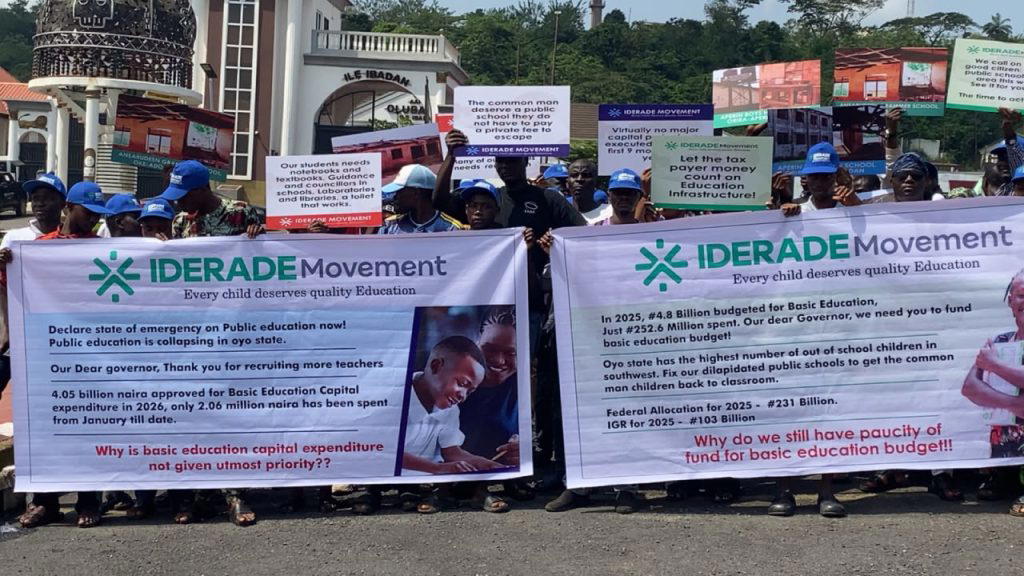
The Iderade Movement has called on the Oyo State Government to declare a state of emergency in the public education sector, accusing the administration of failing to translate increased budgetary allocations and revenue into improved infrastructure and conducive learning conditions in public schools.
The movement, comprising beneficiaries of the education policy introduced by former Governor and current Olubadan of Ibadanland, Oba Rashidi Ladoja, said public schools across the state were deteriorating, with pupils and teachers subjected to deplorable conditions despite the increase in government revenue.
The convener of the movement, Adekunle Moshood, made the call yesterday while addressing a gathering in support of its campaign for policy recognition, insisting that the state of public education required urgent and decisive intervention rather than government publicity.
Moshood said the movement was established by citizens whose lives had been positively transformed by the education policy implemented during Ladoja’s administration between 2003 and 2007, adding that its members were worried about the apparent decline in the quality of public education.
He recalled that the policy provided conducive learning conditions, including a maximum of 30 pupils per classroom, chairs and desks, notebooks for pupils and support for teachers.
“Today is a sad day for those of us who once enjoyed access to quality education in our state. It is pathetic to see many of our public schools in a state of comatose,” he said.
He lamented that schools which should provide better learning opportunities for the younger generation had been reduced to dilapidated classrooms, inadequate furniture and a severe shortage of essential facilities, including laboratories, toilets and libraries.
The movement expressed concern over the reported number of out-of-school children in Oyo State, citing figures presented by Educare Trust in March 2026, which put the number at 674,324, the highest in the South-West.
While acknowledging the state government’s claim that about 65,000 children had been returned to school, Moshood said the figure was insufficient to address the scale of the crisis, with hundreds of thousands of children still outside the classroom.
He argued that the state could not adequately address the challenges confronting the education sector through social media presentations and official figures that failed to reflect the realities facing pupils, teachers and communities.
“We acknowledge some Universal Basic Education and BESDA projects, but the government must be intentional and decisive in the interests of the common man.”
“The federal allocation has increased exponentially and so has Oyo State’s internally generated revenue. Why, then, are our public schools suffering from poor funding?” he queried.
Moshood, however, commended Governor Seyi Makinde for recruiting teachers and increasing budgetary allocations to education since assuming office in 2019, but said the gains were being undermined by poor infrastructure and inadequate releases of approved funds.
He said many newly recruited teachers were working under unacceptable conditions, with some forced to teach under trees because of the absence of functional classrooms.
The movement questioned the disparity between budgetary provisions and actual expenditure, citing the state’s 2025 budget performance report, which reportedly showed that only N252.68 million was spent on basic education out of the N4.81 billion allocated, representing 5.3 per cent implementation.
According to the report, “The state budgeted a sum of N4,810,721,183.05 on basic education and expended 5.3 per cent as at the end of Q4 2025. The reason behind the low performance was because of paucity of funds.”
Moshood said the reported underperformance raised serious questions about the state’s spending priorities, particularly in view of its revenue inflows.
“How can a state that received a federal allocation of N213.75 billion and generated N103 billion in IGR still complain of paucity of funds for a basic education budget of just N4.8 billion?” he asked.
He further alleged that capital expenditure on basic education in 2026 had suffered near-total neglect, claiming that out of the N4.05 billion approved for basic education capital expenditure, only N2.06 million had been spent between January and September.
According to him, the reported expenditure indicated that virtually no major capital project had been undertaken during the period, with zero expenditure recorded for school construction and repairs.
The movement also questioned the priorities of the state government, citing the reported approval of N63.48 billion for the renovation of Government House in June 2025 and a reported N219 billion borrowing in the same year.
“We asked, how much of these funds went to school construction? A child should not have to be born into privilege to receive quality education. Yet, even after struggling to pay taxes, the common man still has no access to quality education in Oyo State,” he said.
The group urged education stakeholders, traditional rulers, community leaders, market men and women, artisans, professionals, journalists and other residents to visit public schools in their communities to assess the situation firsthand and support efforts to improve the sector.
“Let us stop relying on social media performances. If people could feel the impact of quality education 23 years ago without social media, why must social media be the yardstick for measuring impact in 2026?” he added.
The movement outlined seven demands to the state government, including the declaration of a state of emergency in public education, the release of funds allocated for basic education and the publication of detailed accounts of funds received under BESDA, AFTSS and UBEC projects.
It also demanded the disclosure of the proportion of increased federal allocations and internally generated revenue committed to education capital projects, including details of projects, contractors, timelines and implementation status.
Other demands included the publication of current enrolment figures for every local government area alongside WAEC results of public schools; the production of a costed plan to address the estimated 674,324 out-of-school children; and a directive to the House of Assembly’s Committee on Education to convene a public hearing involving the Commissioners for Education and Budget and Planning, as well as the Chairman of the State Universal Basic Education Board (SUBEB).
Moshood stressed that families needed tangible improvements in schools rather than further announcements, listing adequate classrooms, sufficient teachers, textbooks, guidance counsellors, equipped laboratories, libraries and functional toilets as essential requirements.
“Oyo families do not need another announcement; they need classes small enough for teachers to know every child, books, textbooks, guidance and counsellors in schools, well-equipped laboratories and libraries, and working toilets. The public schools do not need to pay a private fee to escape,” he said.
The movement also commended President Bola Tinubu for federal interventions in education, particularly the Nigerian Education Loan Fund (NELFUND) and efforts to address prolonged university strikes, saying the initiatives had helped improve access to tertiary education for students from low-income backgrounds.
Moshood said the movement hoped for further interventions that would enable disadvantaged students to pursue higher education without being compelled to engage in menial jobs to pay their fees.
He explained that the Iderade Movement was initially established in 2019 as the Mada Southeast Young Elites Initiative, through which it organised educational programmes and engaged young people in vocational institutions and communities, before evolving into a campaign advocating quality education for every child.
The movement said the legacy of the former administration demonstrated that quality public education could transform lives, urging the state government to restore the standards that once enabled children from ordinary backgrounds to access meaningful educational opportunities.


No comments yet. Start the conversation.