
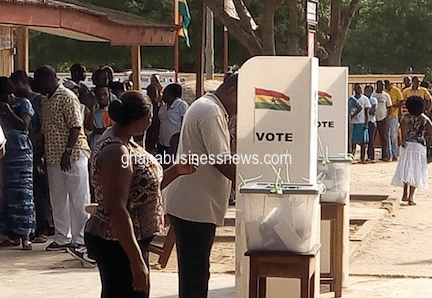
 Whatever power you wield, either administrative or pollical, there is always an expiry date. For those who are in control of corporate organisations, there is always the day to step down. In the corridors of politics, terms end, or the people get fed up at a point.
For this reason, the recent mid-term elections in the U.S. should be an eye-opener to politicians all over the world that, citizens only lend politicians power; they do not surrender ownership of their country
The most dangerous sound in politics is not an opponent’s criticism. It is the silence of citizens who have concluded that their government no longer listens.
Then election day arrives, and that silence acquires a voice. America’s November 2026 midterm elections have delivered such a reckoning. CBS News projected that Democrats will control both chambers of Congress when the new legislature convenes in January 2027. Its latest estimates put the party at least 54 Senate seats and approximately 256 seats in the House of Representatives.
Those figures must not be mistaken for a completed, certified national tally. Some contests remain unresolved. But the projected transfer of congressional control already carries a warning that travels far beyond Washington: yesterday’s political advantage is not tomorrow’s permanent entitlement.
In Texas, CBS News also reports that Democrat Gina Hinojosa defeated Republican Governor Greg Abbott—another reminder that a political stronghold is not a title deed.
For Ghana and the rest of Africa, the lesson is not that American voters have instructed anyone how to vote. It is that no governing party, however confident its leaders or extensive its machinery, owns the people’s consent. Political office is a public trust, not private property.
Trump retains the presidency—not an unrestricted mandate
Donald Trump has not lost the presidency. He faces the loss of the congressional alignment that made advancing his agenda easier. That distinction matters.
A Democratic-controlled House can intensify oversight through hearings, investigations and demands for records. A Democratic-controlled Senate can reject presidential nominees, including nominees to the federal judiciary. Together, the chambers can resist spending proposals and force negotiations over legislation.
These powers are substantial, but they are not unlimited. Congressional investigations must operate within legal boundaries and can encounter disputes over executive privilege and enforcement. Ordinary legislation generally still requires presidential approval, unless Congress overrides a veto with the constitutionally required two-thirds vote in each chamber.
Nor would impeachment automatically remove a president. The House can impeach; conviction in the Senate requires two-thirds of senators present. The likely consequence is therefore not a powerless presidency, but divided government: slower legislation, harder bargaining and greater scrutiny.
Whether that produces useful compromise or destructive confrontation will depend on political choices. Democrats must show that oversight can establish facts and improve government. Republicans must decide whether loyalty to a president outweighs their responsibility to constituents. The accountability demanded of government cannot become a license for opposition irresponsibility.
Ghana has already delivered its own warning
Ghanaians do not need an American election to discover that governments can lose. In December 2024, voters removed the governing New Patriotic Party and returned John Dramani Mahama of the National Democratic Congress to the presidency.
The NDC also secured a commanding parliamentary advantage. A November 2026 report by The Rio Times, citing Parliament’s October membership listings, places the party at 185 members in the 276-seat legislature, against 87 NPP members and four independents. That reported composition puts the NDC just above the two-thirds threshold.
Current membership, however, must be distinguished from election-night results and earlier election records. Disputed returns, subsequent elections and changes in membership can alter the picture. Precision is not a technical nuisance; it is part of responsible political reporting. What is beyond dispute is the scale of the governing party’s opportunity—and therefore its responsibility.
The 2024 election in Ghana followed a period of severe economic distress. The ruling government in 2022 suspended of payments on much of its external debt, inflation, currency depreciation and debt restructuring imposed costs that households could not escape.
In an interview conducted by VOA’s Paul Ndiho on December 13, 2024, Mahama explained his campaign’s emphasis: “All the opinion polls showed the economy and employment were the most critical issues.”
That was the victorious candidate’s assessment, not independent proof of every voter’s motivation. Nevertheless, it identifies the promises against which his administration should be judged. The NDC cannot mistake rejection of the NPP for unconditional acceptance of everything the new government does. A mandate authorises service. It does not suspend scrutiny.
Ghana’s majority must scrutinise its own government
The American and Ghanaian systems are not interchangeable. America separates the presidency from membership of Congress. Ghana’s Constitution requires the majority of ministers of state to be appointed from among members of Parliament.
That arrangement creates a particular accountability challenge: some legislators responsible for scrutinising the executive also serve within it. A large governing majority can pass legislation more easily. But if party discipline becomes stronger than parliamentary independence, oversight can weaken precisely when executive power is strongest.
Ghana’s Constitution does not treat Parliament as a ceremonial endorsement chamber. Article 103 provides for parliamentary committees and gives them significant investigatory powers, including powers relating to witnesses and documents.
Those powers must be used to examine expenditure, appointments, procurement and administrative performance—not merely to embarrass an opposition party’s former officials.
Nor does a two-thirds majority place a government above the Constitution. Entrenched constitutional provisions require procedures that include a referendum; parliamentary numbers alone cannot rewrite them.
The question is therefore not simply how many seats the NDC holds. It is how many of its MPs are prepared to ask difficult questions when the answers may inconvenience their own government. A legislature proves its independence when scrutiny crosses party lines.
A mandate must reach the household
Governments speak in programmes, percentages and policy launches. Citizens experience government through the price of food, the availability of work, the condition of a classroom and the treatment received at a hospital. Both forms of evidence matter. Neither should be manipulated.
Lower inflation, for example, means prices are rising more slowly; it does not necessarily mean prices have returned to earlier levels. Economic growth does not automatically establish that secure employment is reaching young people. A programme’s announced beneficiary count does not, by itself, prove lasting improvement.
Mahama also told VOA: “Job creation is not any event; it is a process.” Fair enough. But a process must be open to examination.
What jobs have been created? How many remain after a subsidy ends? What do they pay? Who qualifies? How much public money has been spent? What evidence distinguishes additional employment from jobs that would have existed anyway?
The government should publish credible targets, methods, expenditure and results. Where independent assessments expose weaknesses, correction should follow—not attacks on the assessors. The same standard applies elsewhere.
Appointments must reward competence rather than proximity. Procurement must withstand scrutiny rather than rely on assurances. Corruption allegations must be investigated when politically connected people are implicated, not only when suspects belong to the opposition.
Illegal mining must be confronted without partisan exemptions. A polluted river does not become less dangerous because the person responsible has the right political connections. An explanation is not a substitute for delivery. A slogan is not an audit.
Opposition is also on probation
The NPP can take encouragement from democracy’s capacity for reversal. It cannot assume that disappointment with the NDC will automatically restore it to office. Opposition must demonstrate what it has learned, which decisions it would change and how its alternatives would work.
It cannot condemn corruption only when opponents benefit. It cannot defend institutions only when those institutions offer protection. And it cannot welcome national hardship because suffering might produce votes.
The same warning applies to America’s Democrats. Congressional oversight should establish facts, protect public resources and correct abuse—not become an endless performance of accusation. Accountability is not revenge. Opposition is not national sabotage. Citizens deserve a government that can be questioned and an opposition capable of answering questions itself.
Botswana supplies an African witness
Botswana’s October 2024 election ended 58 years of Botswana Democratic Party rule. The result was not merely a change of officeholders. It demonstrated that political longevity need not become permanent possession. Reuters quoted 23-year-old student Mpho Mogorosi: “I did not ever think I would witness this change in my life.”
Analyst Ringisai Chikohomero of the Institute for Security Studies told the same news agency: “After 58 years in power (the BDP) didn’t have anything new to offer.”
These were interviews conducted by Reuters, not by this author. Their significance lies in the distance between a governing party’s familiarity with power and citizens’ willingness to continue granting it.
Botswana is not Ghana, and neither is America. Their histories, institutions and electoral choices differ. The shared lesson is narrower—and stronger—than any claim that their elections are identical: incumbency does not erase the possibility of rejection.
But that possibility depends on institutions. Credible elections, independent courts, professional security services, lawful political competition and journalism free from intimidation make peaceful correction possible. Citizens must defend the institutions that allow governments to lose, including when their preferred party is governing.
The ballot remembers—but accountability cannot wait
An election is democracy’s most visible verdict. It is not its only instrument. Ghana’s Right to Information Act provides a route for seeking public records, subject to the law’s procedures and exemptions. Parliamentary proceedings, audit findings and procurement records provide other opportunities to examine how authority is exercised. Citizens can ask their representatives how they voted and why. Journalists can test official promises against budgets, implementation records and independently assessed outcomes.
One household interview cannot describe an entire economy. But it can reveal what aggregate figures conceal. National statistics cannot describe every life. But they can test whether a compelling personal account reflects a wider pattern. Good accountability journalism needs both.
Power surrounds its occupants with people who say everything is well. Democracy protects the right of citizens to say otherwise—and to demand evidence before another election arrives. Today’s majority can become tomorrow’s opposition. Today’s stronghold can become tomorrow’s rebuke. Politicians should govern with that knowledge, not in fear of citizens, but in respect for them. The people are not tenants in a politician’s country.
Politicians must therefore be reminded that, they are temporary occupants of the people’s house.
By Innocent Samuel Appiah


No comments yet. Start the conversation.