
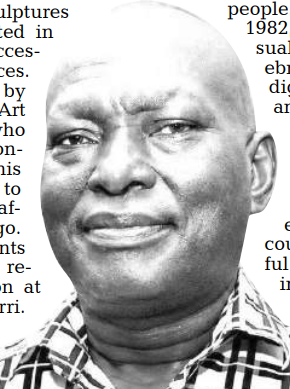
..A master sculptor and exceptional storyteller whose creative works speaks
By Chris Onuoha
Five years have passed since the art and creative community missed Reuben Ugbine, a master sculptor whose artistic vision, creative energy and remarkable storytelling continue to resonate in the history of contemporary Nigerian art.
Ugbine was more than a sculptor. He was a storyteller who gave form to memories, traditions, cultural identities and the everyday experiences of Nigerian people. Working masterfully in clay, wood and paint, he transformed familiar cultural expressions and ordinary human experiences into extraordinary works of art. His sculptures spoke a language deeply rooted in our heritage while remaining accessible to contemporary audiences.
These statement was made by Moses Ohiomokhare, an Art consultant and Curator who served as Reuben’s close confidant and legal trustee to his works, during a media brief to mark Ugbine’s artistic feats after he passed on five years ago.
Born in 1956 to Nigerian parents in Anponya, Ghana, Ugbine received his secondary education at Urhobo College, Effurun, Warri. His formal artistic journey began at Auchi Polytechnic, where he distinguished himself as the Overall Best Student in Art. He subsequently studied sculpture at Yaba College of Technology, Lagos, obtaining his Higher Diploma between 1977 and 1979.
In 1980, he began lecturing at Auchi Polytechnic, where he contributed to the education and development of young artists. He eventually transitioned to full-time studio practice, allowing him to devote himself more fully to his artistic vision and to develop a distinctive body of work that established his reputation as one of Nigeria’s remarkable sculptural voices.
One of Ugbine’s significant contributions was his popularisation of figurative terracotta sculptures inspired by traditional Nigerian costumes and the everyday lives of ordinary people. Beginning in 1982, he developed a visual language that celebrated the character, dignity, occupations and cultural expressions of Nigerians. Through these works, he demonstrated that the familiar experiences of everyday life could become powerful subjects for artistic interpretation.
His mastery of wood carving was equally remarkable. Whether creating monumental figurative compositions or expressive masks, he demonstrated an exceptional understanding of form, scale, texture and material. His works possessed a compelling physical presence, inviting viewers to appreciate not only their craftsmanship but also the stories, histories and cultural meanings embedded within them. His accomplishments in painting further revealed the breadth of his artistic imagination and the versatility of his creative expression.
Ugbine’s artistic practice extended far beyond his studio. He executed numerous commissioned works in Calabar, Abuja, Minna, Lagos, Benin City and other parts of Nigeria. His works also featured in exhibitions in Nigeria and internationally, including in Lebanon, Germany, the Netherlands, South Africa, Ghana and London. These engagements introduced his distinctive artistic voice to diverse audiences and brought Nigerian cultural narratives into wider conversations about art and identity.
His works found platforms through galleries and art outlets including Quintessence, Alexies, Colours of Africa, Signature, ODA Art and Out of Africa. These relationships contributed to the visibility and circulation of his artistic production, making his works accessible to collectors and art enthusiasts.
An Enduring Artistic Legacy
Five years after his passing, Reuben Ugbine’s legacy reminds us of the enduring power of art to preserve cultural memory, interpret society and communicate across generations. His sculptures continue to tell stories of our people, our traditions and our shared humanity.
Artists of his calibre leave behind more than objects of beauty. They leave a visual archive of their time, a body of knowledge for younger generations and a cultural inheritance that deserves to be documented, preserved and celebrated. Through their works, they record aspects of society that written histories may overlook: the gestures of daily life, the dignity of ordinary people, the richness of cultural traditions and the changing character of a nation.
As we remember Reuben Ugbine, we honour the master sculptor, teacher, innovator and storyteller whose hands gave life to clay, wood and paint. His artistic achievements deserve continued study, wider recognition and a permanent place in the documentation of Nigerian art history.
Five years on, we remember him with admiration and gratitude. His hands may have rested, but the stories he carved, moulded and painted continue to speak. His art remains his enduring voice, and his legacy lives on in the history of Nigerian art.
Before his passing, Reuben Ugbine entrusted his sculptural studio and artworks in Benin City to his son, Ogaga Reuben Ugbine, who is the authorised custodian of his father’s original works. This custodianship represents an important responsibility: to protect the integrity of the collection, preserve the artist’s working environment where possible, and ensure that his artistic achievements remain accessible to future generations.
The passing of an artist can leave a body of work vulnerable to fragmentation. Artworks may become dispersed among private collections, photographs and archival records may be separated, and important information about commissions, techniques, influences and the circumstances surrounding individual works may gradually disappear. Without deliberate documentation, valuable aspects of an artist’s contribution to cultural history risk being lost.
For this reason, the fifth anniversary of Reuben Ugbine’s passing should be more than a commemorative occasion. It should mark the beginning of a sustained initiative to document, preserve, interpret and promote his artistic legacy.
Ogaga Reuben Ugbine, working in collaboration with Moses Ohiomokhare, will support and develop this effort, with the aim of building a reliable record of the artist’s life, practice and achievements.
The initiative will seek to document surviving artworks, record their provenance where information is available, assemble photographs and exhibition records, preserve relevant archival materials, and gather testimonies from family members, fellow artists, collectors, galleries and other individuals who knew or worked with him.
The long-term ambition is to establish a structured archive that will support research, exhibitions, publications, educational activities and wider public engagement with Ugbine’s work. Through these efforts, his artistic legacy can be preserved not merely as a collection of objects, but as a continuing cultural resource.
Continuing the Legacy: From Custodianship to Public Engagement
Ogaga Reuben Ugbine has already taken steps towards sustaining his father’s artistic presence. Between 2022 and 2025, he maintained a working relationship with ODA Art Gallery, exhibiting original works by his father and helping to keep the artist’s work before collectors and the wider art community. In 2026, Ogaga also exhibited at Bowman Sculpture in London, marking a further engagement with the international art world.
These activities provide a foundation upon which a more comprehensive legacy programme can be developed. By combining responsible custodianship with professional curatorial support, archival documentation and strategic exhibition opportunities, the initiative can help ensure that Reuben Ugbine’s contribution receives the recognition and scholarly attention it deserves.
The task ahead is a cultural undertaking. It calls for collaboration among galleries, museums, collectors, art historians, cultural institutions and government agencies, as well as all those who value Nigeria’s artistic heritage.
Five years after his passing, the most meaningful tribute we can offer Reuben Ugbine is to keep his stories alive: to preserve his works, document his achievements, share his artistic vision and ensure that future generations encounter the depth, humanity and cultural significance of his art.
Reuben Ugbine lives on through the stories he carved, the memories he moulded and the cultural heritage he left in our hands.



No comments yet. Start the conversation.