
By Femi Ishola
The ribbon-cutting ceremony is one of the most familiar rituals of political leadership. It provides the photographs, the speeches and the enduring images of public projects.
Rarely does it disclose the complex, sometimes frustrating process through which those projects move from conception to completion.
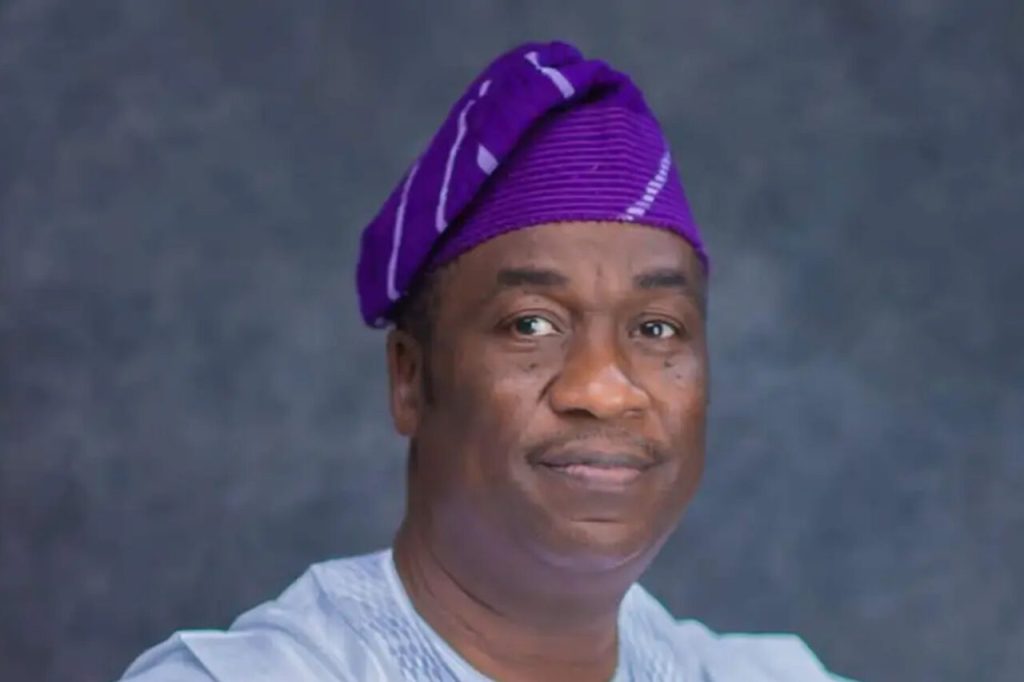
Governor Babajide Sanwo-Olu made that distinction central to his assessment of Dr. Obafemi Hamzat at Friday’s presentation of the latter’s governorship manifesto in Lagos.
“When the Blue Line ran its first train, when the Red Line opened, when the first ship came into the Lekki Deep Sea Port, he was in the room.”
Then came the more revealing part.
Before the ribbons were cut, the governor explained, Hamzat had been present in the earlier room, where drawings were examined, contractors questioned and technical decisions considered.
It was a deliberate attempt to shift public attention from the celebration of finished projects to the less visible responsibilities involved in their delivery.
For a candidate whose governorship ambition is substantially anchored on continuity, that distinction is particularly relevant.
Hamzat is an engineer by training, with a doctorate and experience in the management of public infrastructure.
He previously served as Commissioner for Science and Technology and, later, Commissioner for Works and Infrastructure under successive Lagos administrations.
Those appointments provided the background against which Sanwo-Olu sought to explain Hamzat’s involvement in some of the state’s contemporary infrastructure programmes.
But the governor’s account went further. He linked Hamzat’s earlier responsibilities to the development of modern Lagos across different administrations.
He recalled his appointment to the Ministry of Science and Technology in 2005 and credited him with aspects of public-sector computerisation, payroll reform and the foundations of the state’s resident-registration system.
He also highlighted Hamzat’s subsequent stewardship of Works and Infrastructure under Governor Babatunde Fashola, including the delivery of the Lekki-Ikoyi Link Bridge.
The references were significant because they located the candidate’s experience beyond the confines of the present administration.
Indeed, Sanwo-Olu appeared intent on establishing that Hamzat’s public-service record was cumulative, traversing administrations, policy priorities and different stages of the state’s development.
Yet the deeper implication was his treatment of technical experience as a political issue.
Modern Lagos is not short of ambitious projects. Its recurring difficulty lies in the relationship between infrastructure demand, financing, execution, maintenance and the rapidly expanding needs of residents.
Rail networks, highways, ports, aviation facilities, drainage systems and logistics corridors require long planning horizons. They also demand institutional coordination that cannot be captured adequately by campaign photographs.
This was the context in which Sanwo-Olu cited the second phases of the Blue and Red rail lines, the Fourth Mainland Bridge, the Lekki-Epe International Airport, the Omu Creek project and planned food hubs.
He presented these initiatives as works in progress that would extend beyond his tenure.
The argument is understandable. Some infrastructure commitments cannot reasonably be delivered within a single four-year term. Where implementation cuts across administrations, changes in leadership can produce delays, alterations in priorities or uncertainty over funding.
But continuity also requires scrutiny. Not every project inherited by a government necessarily deserves completion on its original terms. Circumstances change, costs rise, designs become outdated and public priorities shift.
The most useful interpretation of the governor’s argument is therefore not that every existing decision must be preserved, but that institutional knowledge can help a new administration distinguish between what should be completed, corrected or reconsidered.
Sanwo-Olu himself seemed to acknowledge this when he said continuity involved finishing what was started, fixing what was not working and initiating what comes next.
That qualification gives the speech greater policy relevance than a simple appeal to preserve the status quo. The references to Hamzat’s technical participation also carry an important burden of proof.
Presence in planning meetings does not, on its own, establish responsibility for successful delivery. Major projects such as the Lekki Deep Sea Port involve several public and private institutions, with decisions and responsibilities distributed among different actors.
The governor’s testimony is evidence of the role he says Hamzat played. A fuller assessment would require examination of particular decisions, implementation records, financial commitments and measurable outcomes.
For the campaign, however, the important point is that a line of inquiry has been opened.
Hamzat is being presented not merely as someone familiar with Lagos’s projects but as a participant in their conception and management. That creates an opportunity for the electorate to interrogate him on timelines, costs, engineering choices and practical benefits.
The significance of the speech lies in this connection between political succession and the unfinished business of development.
Sanwo-Olu used the occasion to argue that Lagos’ next phase cannot be considered independently of the projects already underway.
And by returning attention to the earlier room, where drawings were still on the table and difficult questions remained unanswered, he offered a reminder that governing a modern city involves much more than presiding over the ceremonies that announce its achievements.
For Hamzat, the challenge is now to translate that claimed familiarity into detailed, independently assessable proposals for completing the work ahead.
•Ishola is a Lagos based public affairs analyst


No comments yet. Start the conversation.