
By Osa Mbonu-Amadi
Nature masterfully designed it that at a certain point every month in the life of a woman, a ripe biological egg embarks on a reproductive journey from the ovaries through the follapian tube, expecting to encounter a spermatozoa that will fertilize it. If the egg meets the right sperms, it is fertilized, and the result would be a pregnancy, which ensures the reproduction and sustainance of life on earth. But in the event that it fails to encounter any sperm in that monthly journey, the egg, which is largely made of blood, is crushed and the blood expelled through the vargina.The is what is called menstruation.
In most societies, women who do not experience this menstrual circle are considered to be deformed in life, because without menstruation, the woman stands the risk of being barren, and barreness, especially in Africa, comes with one of the worst kinds of stigmas imaginable.
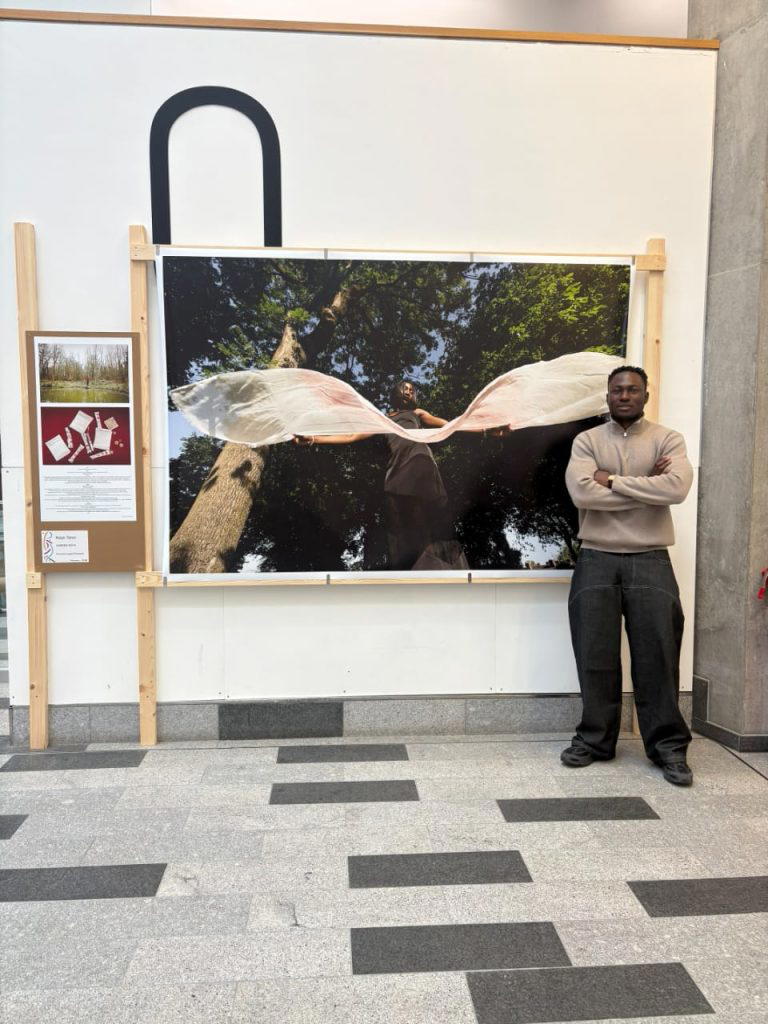
Yet, women who are under menstruation are considered unclean and somewhat stigmatised. What a contradiction! And how can this contradiction be resolved? These are the thorny issues the fine art photographer, Ralph Adebayo Taiwo, contends with in his body of work titled Unseen Days.
Unseen Days is therefore a timely project aimed at confronting this paradox at the core of menstrual experience. How could this same menstruation be regarded as evidence of womanhood and fertility, and at the same time something for which women experiencing it are regarded as unclean and therefore quarantined as long as the menstruation lasts? This way, the artist turns a biological process which is normally hidden, into a public debate where issues about dignity, health, inequality and human rights are discussed.
Contradiction is a central theme in this work. But Taiwo’s Unseen Days rejects this contradiction, insisting that menstruation should neither be simply seen as proof of womanhood nor as something that makes women unclean, even while it lasts. For him, menstruation is a normal bodily reality. The stigma, anxiety, restricted movement, and lack of access to products are not natural or inevitable. With this interpretation, Unseen Days and its creator demphasise women’s bodies in the conversation and highlight, for the purpose of abrogation, the social system that stigmatises it.
The foregoing constitutes the artist’s intervention. Here is a fine-art photographer, using visual storytelling to beam light on feminine experiences that are usually hidden. Hence, in his artist statement Taiwo clarifies that Unseen Days is not just about blood or biology, but about the “physical pain, emotional distress, social stigma, and vulnerability” that can accompany menstruation.
Perhaps the most significant dimension of Unseen Days is the attention it draws to the problem of women who have no access safe, hygienic, and affordable menstrual products. This problem is worrisome in Nigeria where it is estimated that about 37 million Nigerian women and girls face period poverty, which means they lack access to safe, hygienic, and affordable menstrual products.
The unavailability or unaffordability of menstrual products can, and does affect young girls’ school attendance, participation in social activities, and self-esteem. Taiwo’s work therefore connects menstruation, something that takes place privately in the body of a woman, to the more global issues and questions about social justice.
Unseen Days also strives to transform silence into speech. In Africa and many other parts of third world countries, there are a lot of misinformation, superstition, and taboo about menstruation. All these create barriers and prevent women and girls from seeking information or support. Unseen Days tries to dismantle those barriers.
As a project that turns invisibility to recognition, and suffering to demand for dignity, Unseen Days becomes both a poetic and political force. Taiwo’s work therefore goes beyond an exhibition about menstruation. It argues that access to menstrual care is not a privilege but a necessity. This way, Unseen Days uses art as an advocacy tool, a role art has comfortably played from time immemorial.
The artist and this symbolic work invite viewers, especially men, policymakers, educators, and community leaders, to abandon their actions and beliefs that sustain stigma and embrace those that make for positive change.
Unseen Days establishes the artist, Ralph Adebayo Taiwo, as an activist who fights for gender equity, feminine dignity, and social repairs generally.
By using photography to draw attention to the realities of menstruation, Taiwo challenges societies involved in the contradiction of celebrating fertility and at the same time stigmatising the very biological process that makes it possible to desist.




No comments yet. Start the conversation.