
By Etop Ekanem
Tropical General Investments (TGI) Group has highlighted the importance of practical, community-driven approaches to sustainability and business growth at the Bank of Industry (BOI) 2026 Sustainability Conference in Lagos.
Two senior executives of the Group shared their views during separate fireside chats at the conference, held on November 17 at The Civic Centre, Victoria Island. Their discussions focused on building resilient food systems, managing climate risks in agriculture and creating long-term business value.
Gumel Advocates Practical Approach to Sustainability
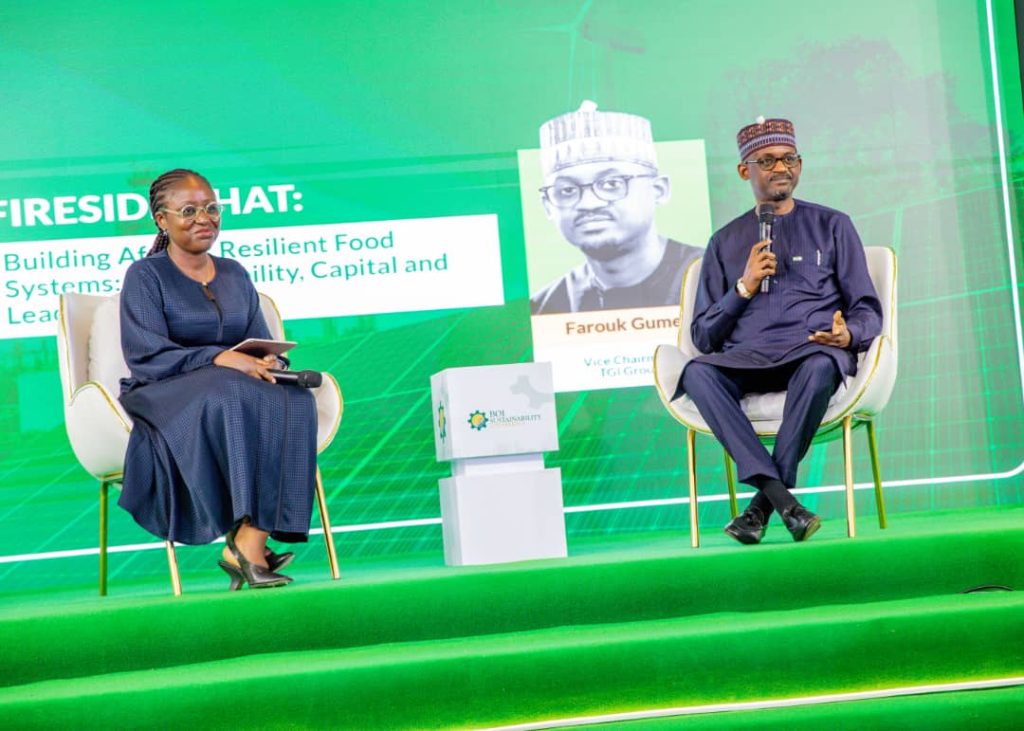
Farouk Gumel, Executive Vice Chairman of TGI Group, spoke on “Building Africa’s Resilient Food Systems: Sustainability, Capital and Leadership at TGI.” The session was moderated by Mrs. Eniola Akinsete, BOI’s Chief Sustainability Officer.
Gumel said TGI’s approach to sustainability is rooted in solving practical problems and improving the lives of people in the communities where it operates.
“We don’t start a venture thinking about profitability or thinking about sustainability. We start our businesses thinking about how to solve a problem,” he said.
He explained that the Group’s businesses, including BIG BULL Rice, Terra Seasoning Cubes, Golden Terra Vegetable Oil, Renew Starch and Chi Farms, depend on strong relationships with local communities and agricultural suppliers.
Rather than owning farms and plantations, Gumel said TGI works with outgrowers and local suppliers to strengthen agricultural production and create economic opportunities.
He cited the Group’s joint venture with Wilmar International, which covers about 40,000 hectares of oil palm plantations in Cross River State, as well as its shea nut sourcing operations in Kwara State, where women’s groups participate in the supply chain.
On the business case for sustainability, Gumel said agricultural businesses require large production volumes and long-term investment to remain profitable.
“Profitability in my sector means high volume, low margin. If you don’t have volumes, don’t play this game,” he said.
He also encouraged business leaders to focus less on discussions and presentations and more on implementation.
“Let’s do less grammar. Let’s just go and do it,” he said, stressing the need for practical steps towards industrial development.
Onanuga Highlights Climate Resilience in Agriculture
In another session, Yosola Onanuga, Head of Corporate Responsibility and Sustainability at TGI Group, discussed how WACOT Rice, a member of the Group, responded to climate-related risks.
The session, titled “When the Weather Became a Business Risk: How WACOT Rice Rebuilt Its Value Chain for Resilience,” was moderated by Mr. Chike Chukwuelue of BOI.
Onanuga explained that climate change has become more than an environmental concern, as events such as flooding can disrupt farming, reduce production, affect revenue and create financial challenges for businesses.
“When a risk can materially affect earnings or cash flow, it naturally becomes a boardroom issue,” she said.
She identified investment in people as one of the most important lessons from WACOT Rice’s experience, noting that technology, infrastructure and data can only deliver lasting results when people have the skills and knowledge to use them effectively.
On access to finance, Onanuga said investors and financial institutions increasingly look beyond individual projects to understand how businesses manage risks, create value and measure their impact.
She urged companies to make sustainability part of their business strategies rather than treat it simply as a compliance requirement.
“Compliance may help you meet a requirement. Strategy helps you create value,” she said.
WACOT Rice Wins BOI Sustainability Award
Earlier at the conference, WACOT Rice Limited received the Award for Outstanding Corporate Leadership in Sustainable Practices.
The award was presented by Dr. Olasupo Olusi, Managing Director and Chief Executive Officer of BOI, in recognition of the company’s efforts to integrate economic, environmental and social considerations into its business operations.
Its initiatives include an outgrower programme and a captive power co-generation facility that generates one megawatt of electricity using rice husks.
The conference, themed “Green, Resilient & Profitable: Redefining Nigerian Businesses for a Sustainable World,” brought together business leaders, policymakers, investors and development finance experts to discuss ways to promote sustainable industrial growth in Nigeria.




No comments yet. Start the conversation.