
South Africa can be such a place of contradictions. Just two years ago President Cyril Ramaphosa declared in his inauguration speech that the people had, through their votes which resulted in the nation’s hung Parliament, “made plain their expectation that the leaders of our country should work together… put aside animosity and dissent, to abandon narrow interests, and to pursue together only that which benefits the nation”.
He pronounced from his podium at the Union Buildings that “the formation of a government of national unity is a moment of profound significance. It is the beginning of a new era.” That it certainly was. Those who are prone to hyperbole even compared it to 1994, when parties across the racial and ideological divide forged the country’s first government of national unity. This time the GNU was not forced by the need to end a war and forge a new society, but was imposed by the voters themselves who wanted a new direction for the country.
The result of the 2026 local government elections reflected a desire for an advance on that “moment of profound significance” on the part of the electorate. Voters sent a strong message to political parties to work together to focus on urgently fixing municipalities, universally recognised as the coalface of government. At the polls they rejected misgovernance, malfeasance and corruption. In doing so they demanded effective governance, regardless of who would be in charge of their cities and towns. Yet in the aftermath of that clear directive from the electorate, the parties, including Ramaphosa’s own ANC, have turned the outcome into a platform for a fight over issues that have nothing to do with the coalface life of the people.
Within the ANC the debate over who to partner with in the metros and secondary cities has been dominated by ideological assessments of its relationship with the DA in national government. As the party went into survivalist mode following the cataclysmic results, the strategic objective became about how to keep the DA out of power rather than how to forge the best governments.
Ramaphosa, who in 2024 stuck his neck out and drove his party in the direction of the deal that achieved the moment he celebrated in his inauguration, even brought his own current feelings about the DA into the conversation and chose to be led by his lieutenants rather than lead.
In the middle of the most profound negotiations about the turnaround of the engine rooms of growth he jetted out to California with 300 of his best buddies to hang out with the tech bros. He may have been checking in regularly and joining virtual meetings but he knows that nothing beats being on the ground and having in-the-flesh consultations with your negotiating team and even reaching out to peers on opposing sides to iron out creases. Instead, in an extraordinary display of how much he has checked out of his job, he abrogated leadership and handed it to ANC secretary-general Fikile Mbalula, South Africa’s answer to Albert Einstein.
 Fikile Mbalula – South Africa’s answer to Albert Einstein. (Photo: Gallo Images / Brenton Geach)
The negotiating strategy of Mbalula, particularly in Gauteng, closely aligned with that of ActionSA leader Herman Mashaba. He too based his strategy on his deep-seated personal grievance with DA Johannesburg mayoral candidate Helen Zille, even declaring that the “toxic” relationship between the two of them would prevent two parties from finding each other. Never mind that the more than 1.6 million people who voted for ActionSA wanted the best possible governments and could not care less about personal animosities. He then tapped into the oft-repeated trope about the DA being a racist party that did not care about the needs of black communities. He did so as he delivered his party’s support into the hands of an ANC whose deep care for the people is evident in free-flowing clean water and uninterrupted power supply, safe neighbourhoods, smooth roads and other top-grade service delivery in townships and informal settlements throughout the land.
Then you had the so-called left parties, gathered under the umbrella of the Conference of the Left. These parties and organisations have also made fighting the DA their raison d’etre. As negotiations were gathering steam they gathered in Ekurhuleni to chart some common positions that they would be taking to potential partners. SACP general secretary Solly Mapaila outlined the bottom line of the deliberations as convincing “all organisations, particularly those that were voted by the African majority, to work together as a bloc in councils and prevent the DA and the Freedom Front from leading our people”.
He paid lip service to what the elections were about, saying that “local government really deals with… water, electricity, sanitation, and therefore it is not really a place for ideological contestation”. Then, without missing a beat, he stated that “our contradictions against what the DA and its allies stand for will remain because they represent the forces of reaction. And we will say all these things we are saying here; we’re not going to mince our words.”
There was a lot of talk among those present about “black parties” having garnered about 50% of the vote, with the Conference of the Left components getting 20% of this and the ANC just over 31%. Together, these black parties would be able to defeat the forces of reaction – the “white parties” – and they advised the ANC to rather work with them to this end. This potpourri of left parties that wants to save the country from the forces of reaction and prevent white monopoly capital from seizing government includes the poster boys of good governance and ethical rectitude, such as Jacob Zuma’s MK party, former Free State premier Ace Magashule’s African Council for Transformation and Floyd Shivambu’s Afrika Mayibuye Movement.
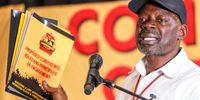 SACP general secretary Solly Mapaila addresses the Conference of the Left at the Birchwood Hotel & OR Tambo Conference Centre in Boksburg on 29 May 2026. (Photo: by Gallo Images / OJ Koloti)
Monumentally immature
This is by no means an argument that a party such as the DA should be an automatic shoo-in for service delivery, good governance and vibrant local economies. The politics of the DA are far from ideal and should be contested at all times by its opponents. But to bring empty ideological arguments and personal beefs into considerations about ending our municipal governance disasters is monumentally immature. Coalition governments are constituted because there are different political parties that get the votes of the electorate. Different political parties exist because they hold divergent political beliefs and have different ideas about solutions to societal challenges. Successful coalitions work because these parties are able to find common platforms and put forward their best minds and experiences to solve problems and drive development.
Even if the DA were to find itself frozen out of the major city governments, which is likely, it should be for the right reasons and after the kind of exhaustive negotiations that those plotting to exclude it have been having among themselves. It should have been excluded because of a failure to find common positions about how best to serve the voter and the non-voter or because it was just plain useless. What we have seen in this process has been the knee-jerk taking of positions by party ideologues and thin-skinned individuals with hurt feelings.
The residents of our towns and cities have not been top of mind.
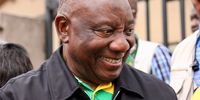 President Cyril Ramaphosa engages with residents in Ward 14, Thembisa, Ekurhuleni, during the ANC’s door-to-door election campaign trail on 4 September 2026. (Photo: Reitumetse Pilane)
In remarks reminiscent of his inauguration speech, Ramaphosa said at the results announcement two weeks ago that “the voters have given their representatives a responsibility to work together, even where they differ”, urging parties to put the public good over positions, privileges and the distribution of power.
Missing from the conversation now is the Ramaphosa who said in that speech that “the stability of our municipalities cannot be sacrificed to narrow political interests. The delivery of essential services cannot be held hostage by political disagreements.” The man who has told us repeatedly in the past 18 months how important saving our metros is, just didn’t seem to care.
If there is any stronger indication that his mind is on watching the waves crash on the shores of Fresnaye or tending to his varied herds of beasts, it is this. DM



No comments yet. Start the conversation.