
By Stephanie Shaakaa
In September 2022, when my father, Chief Tegh-Tegh Shaakaa Adagba, JP, turned 74, he declined a grand celebration. When asked why, his answer was disarmingly blunt: despite his personal blessings, a thriving family of scholars, chartered accountants, soldiers, technocrats, entrepreneurs and doctors, he did not feel fulfilled.
How could an elder consider his life complete when the communities of Southern and Central Taraba, where he had spent decades mediating peace, remained scarred by deserted villages, burnt schools and recurring ethnic violence?
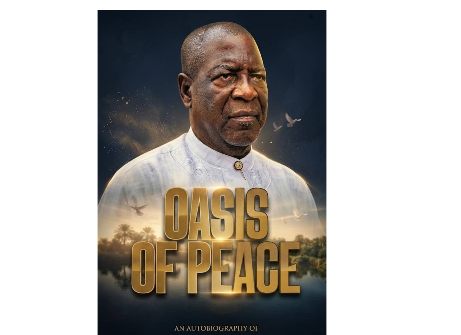
Four years later, at 78, he has put that burden into words. On Saturday, November 28, 2026, he will present his autobiography, Oasis of Peace. It is far more than a personal chronicle. It is a record of a region’s troubled history, a firsthand account of the search for peace, and a sobering reminder to a country still struggling to contain violence across its Middle Belt.
Born in 1948 in Kadarko Ward, Donga Local Government Area of Taraba State, Chief Shaakaa built a successful business career across Kaduna, Gboko and Abuja, where his firm was the first to complete its section of the NYSC Orientation Camp in Kubwa. Having established himself professionally, he returned home in 1991 to serve his community. That decision would gradually draw him into some of the most difficult social and political challenges facing his people.
A decade later, when the 2001 Tiv-Jukun and Tiv-Fulani crises erupted, the mantle of leadership fell on him. As President General of the Taraba State Tiv Cultural and Social Association (TCSA) from 2001 to 2005, he stood in the eye of the storm, burying the dead, managing displaced populations, petitioning Abuja and Jalingo, engaging traditional authorities and sitting across tables with adversaries to negotiate fragile truces.
There is a human dimension to this work that should not be lost beneath the titles and positions. Peacebuilding in communities torn apart by violence is rarely a comfortable undertaking. It means confronting grief, listening to competing accounts of injustice, dealing with people who have lost confidence in one another and returning to difficult conversations even when the prospect of agreement appears remote. It requires an elder to understand that the people on the other side of the negotiating table are not going to disappear simply because relations have broken down. They remain neighbours, and sooner or later, the question of how to live together must be answered.
This is the burden that runs through my father’s memoir. His concern has never been limited to the immediate resolution of a particular crisis. It is also about what happens afterwards: whether displaced families can return, whether children can attend school without fear, whether communities can rebuild their livelihoods and whether a generation raised amid hostility can recover the confidence to live alongside people it has been taught to distrust.
Yet what makes Oasis of Peace compelling for a national audience is not merely the résumé of a peacemaker, but his refusal to indulge in comfortable ethnic victimhood. Writing with the candour of an elder who knows time is short, he interrogates the structural, political and moral failures that have turned neighbours into enemies. His reflections are uncomfortable in places precisely because he does not spare his own people from scrutiny. He recognises that reconciliation cannot begin with selective memory or the convenient assignment of blame.
To explain the protracted Tiv-Jukun conflict, my father draws on a childhood hunting lesson from his own father: when you shoot an arrow and miss, stand on that exact spot and shoot a second arrow in the same direction to find the first. His message to his kinsmen is uncompromising: “It is with the Jukuns that our ship of political and socio-economic prospects has sunk. Therefore, it is only with the Jukuns that we can recover the lost prospects.”
There is considerable wisdom in that argument. Reconciliation with a community with which one has experienced conflict is not an admission of defeat, nor does it require pretending that the injuries of the past never occurred. It is an acknowledgement that shared geography, history and economic interests cannot simply be wished away. The people who have become adversaries may still be the people with whom a sustainable future must be negotiated. The second arrow, in this sense, is an invitation to return to the point where relationships broke down and find a way forward.
That conviction is rooted in lived memory rather than abstract idealism. Today’s younger generation in Southern Taraba is being raised on inherited suspicion and rigid indigene-settler binaries. My father reminds them of a forgotten era when virtually every rural Tiv family had a trusted Jukun host in town where their children lived to attend school. He himself grew up inside the palace of the Chief of Donga, His Majesty Sambo Garagbosa (Tor Gaba), where visitors mistook him for the monarch’s biological son.
Back then, the Chiefs of Wukari, Donga and Takum maintained residences in Makurdi and Kaduna that served as open sanctuaries for travellers from their domains, regardless of tribe or faith, known simply as Mutanin Wukari, Mutanin Donga or Mutanin Takum. These were not merely convenient places to lodge. They represented a culture of hospitality and mutual trust in which ethnic identity did not automatically determine who could be welcomed, protected or treated as family. That such memories now seem distant is an indication of how much the region has lost.
Equally piercing is his examination of the Tiv-Fulani crisis. Pointing out the economic asymmetry of rural warfare, he notes that while pastoralists can move with their cattle, farmers’ wealth is fixed in the soil. When violence strikes, the farmer does not simply lose a harvest; he may lose the land, the home, the tools, the years of labour invested in it and the means of feeding his family. The destruction therefore extends beyond the immediate violence, often wiping out the economic foundation upon which entire households depend.
Yet my father refuses to treat the conflict as inevitable. Recalling the age-old joking kinship, bawa-na, between both groups and the historical political alliances that saw Northern leaders like Sir Ahmadu Bello, Shehu Shagari and Umaru Musa Yar’Adua appoint Tiv statesmen to key federal offices, he reminds readers that coexistence was once the norm, not an impossible dream. His point is not that history was without disagreements, but that differences did not always make peaceful relationships impossible.
More importantly, the memoir documents how Nigeria once found a working formula and squandered it. Following Chief Shaakaa’s shuttle diplomacy across Northern emirates and state capitals, the Sultan of Sokoto constituted a high-powered committee on Tiv-Fulani relations, chaired by the Emir of Gombe, with the Tor Tiv as Vice Chairman. Supervising mediation across Taraba, Benue and Nasarawa States, my father witnessed clashes fall to near zero in areas where the committee’s core rules were enforced: an absolute ban on collective reprisal killings, recognition of local Ardos, demarcated grazing corridors and border checks on foreign herders.
The significance of this experience deserves greater attention in today’s national conversation about insecurity. It demonstrated that peacebuilding required more than public appeals, ceremonial meetings and expressions of sympathy after violence. It required recognised traditional authorities, clear rules, communication between communities and the willingness to enforce agreements. The arrangement offered a practical framework for coexistence, but partisan politics eventually derailed it. That failure raises an uncomfortable question: how many lives might have been spared if a functioning peace mechanism had been protected from political interference?
Perhaps the bravest pages of the memoir are reserved for self-indictment. Rather than blaming outsiders alone, Chief Shaakaa confronts what he calls the “war within”: the rise of intra-Tiv banditry and vigilante justice along the Benue-Taraba border. He argues that this internal violence has claimed more Tiv lives and destroyed more property than the Jukun and Fulani conflicts combined. When youths lose respect for elders and weaponise criminality, communities destroy themselves from the inside out.
This is where his argument becomes particularly important. It is easier to condemn wrongdoing when it comes from another ethnic group than when it is committed by one’s own people. But criminality does not become acceptable because its perpetrators share one’s ancestry, just as vigilante violence does not become justice simply because it is presented as retaliation. A community that genuinely desires peace must be prepared to confront wrongdoing within its own ranks. My father’s willingness to make that argument is among the strongest indications that his understanding of reconciliation goes beyond ethnic solidarity.
For policymakers in Abuja, Jalingo and Makurdi, Oasis of Peace carries an unmistakable warning: commissions of inquiry whose White Papers gather dust will never heal the Benue Valley. Nigeria does not necessarily need to invent another peace framework. It needs to revisit and revive structures that once worked, restore traditional consultative mechanisms, enforce land and grazing demarcations, punish collective reprisals and criminal violence without ethnic favour, and ensure that recommendations from previous inquiries do not end up forgotten in government archives. Just as urgently, it must teach a generation poisoned by historical amnesia that their grandparents once shared roofs, schools, friendships and political power.
The launch of Oasis of Peace: An Autobiography of Tegh Tegh Shaakaa Adagba will take place on Saturday, November 28, 2026, at 12 noon at the FUW Wukari Auditorium. The occasion will be chaired by Hon. Uba Maigari, Minister of the Federal Ministry of Regional Development, with the Governor of Taraba State as Special Guest of Honour. Senator David Jimkuta will serve as Chief Launcher, while His Majesty, Dr. Ishaku Adda Ali Matakhitswen, the Aku Uka of Wukari, is Chief Host. HRH Ambassador Sanvala Vorzoe Shimbura (Gargbenyi II), Gara Donga, is Father of the Day, and the book will be reviewed by Professor Samuel A. Apinega of the Faculty of Law, Ahmadu Bello University, Zaria.Mrs Agyin Kefas, wife of the Governor, as Mother of the Day.
As my father writes in one of the book’s most arresting lines: “Unless an earthquake occurs, the unforeseen type that would fling people to different worlds and planets, Tiv, Jukun and Fulani ethnic groups would continue to co-exist, side by side, till eternity.”
Nigeria cannot wish its fault lines away. If we are serious about turning the Benue Valley from a theatre of grief back into the nation’s food basket, we would do well to pick up the second arrow and aim it where peace once lived.
The communities of the Benue Valley cannot change the fact that they share the same land. They can, however, decide whether that shared inheritance will remain a source of perpetual conflict or become the foundation of a more peaceful future. My father’s memoir is a reminder that the relationships destroyed by violence were once possible, that the mechanisms for rebuilding them have existed, and that the responsibility for recovering them cannot be postponed indefinitely.
The second arrow is still waiting to be released.
Stephanie Shaakaa
shaakaastephanie@yahoo.com
08078600871



No comments yet. Start the conversation.